Satellite-derived maps of defoliation caused by European spongy moths – a devastating U.S. forest pest that consumes the leaves of a wide variety of trees – offer a promising solution for tracking where and when to spray and for identifying large scale trends and conditions that lead to pest outbreaks, according to a new study.
The research, published online in the journal Forest Ecology and Management, also offers evidence that warm, dry summers might predict an outbreak the following year, as the main pathogens that kill the moth’s larvae require moisture to thrive, which means higher numbers of moths survive to lay eggs that hatch in the subsequent spring.
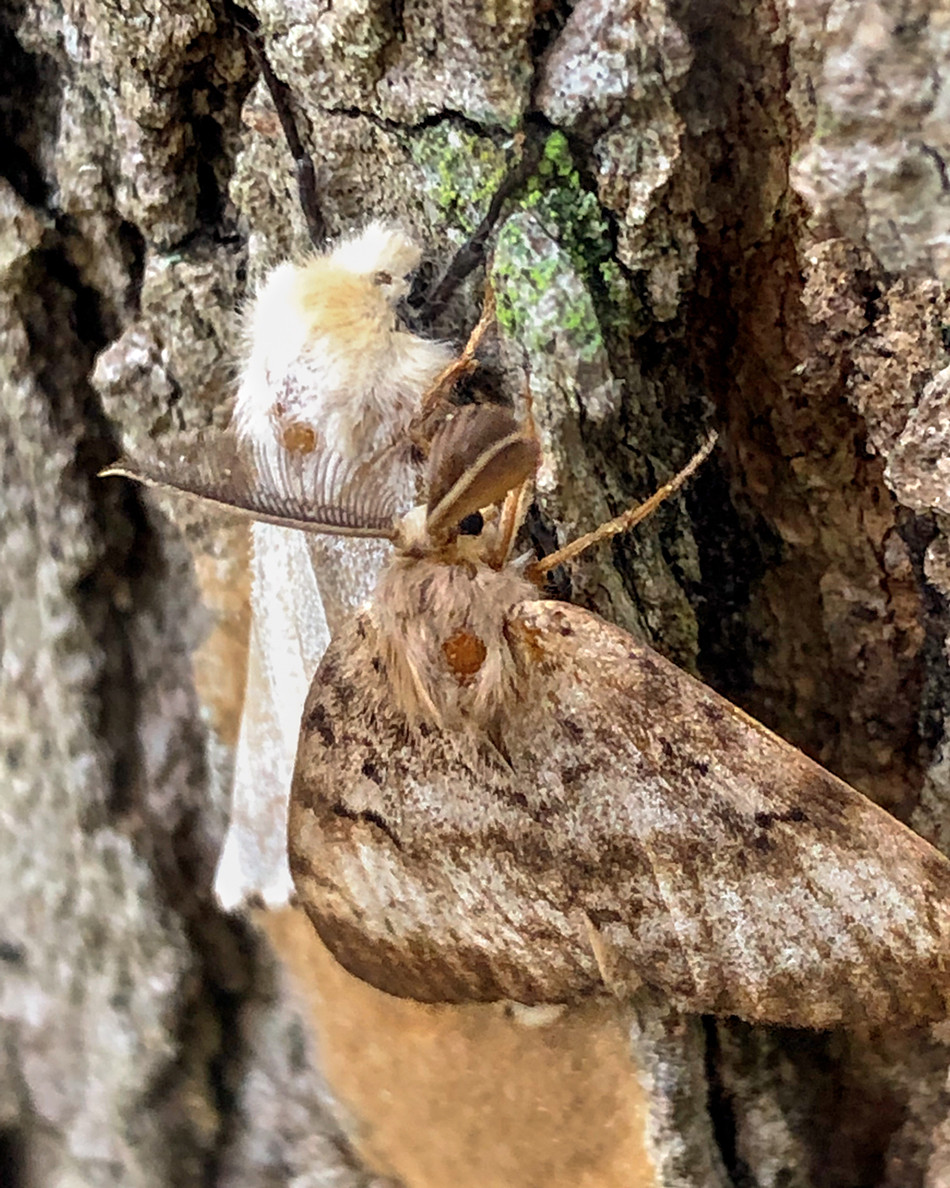
An adult European spongy moth.
The paper describes a new algorithm that robustly quantifies European spongy moth defoliation using high-resolution satellite imagery of forest canopies. The study’s authors created a defoliation index based on time series of satellite images, which provides insight into whether the greenery has changed over short periods.
Damage from European spongy moths has been difficult to track because it occurs in scattered spots and changes quickly early in the growing season.
“Our ability to actually track and project where we’re going to see high risks means we can have land mangers on alert, paying more attention and possibly spraying insecticides and handling management activities,” said first author Cameron Scholl, a doctoral student in the lab of Xiangtao Xu, associate professor of ecology and evolutionary biology in the College of Agriculture and Life Sciences and the paper’s senior author. “It helps a lot, especially considering surveillance on the ground is labor intensive.”
To identify where to spray for European spongy moths, land managers need to search over large areas in spring for small egg masses and larvae. “Any bit of information that tells people this is where you should be putting your efforts can help,” Scholl said.
European spongy moths – native to Europe, Asia and North Africa – were first introduced in Massachusetts in 1869. Without local natural predators, they have now established populations from North Carolina to mid-Ontario on the East Coast, and as far west as western Wisconsin. The larvae are known to feed on some 300 tree species.
“When they reach high populations, they will eat almost all the leaves off every tree,” Scholl said. Deciduous trees can often quickly regrow leaves in spring once the caterpillars move on or become adults, since the species produces only one generation per year and adult moths lay eggs but don’t eat. But conifers and evergreens are not adapted for quickly regrowing all of their foliage, which means moth outbreaks can lead to higher rates of mortalities for these species.
In the study, the researchers found some evidence that large outbreaks with high defoliation were associated with warmer, drier summers the year before. The finding matches well with European spongy moth biology, as pathogens that kill them require moisture and don’t infect well in warm, dry weather. “So when there are warmer and drier summers the year before, all the larvae survive to adulthood, and there are many more eggs the next year,” Scholl said.
To locate outbreaks, the researchers used time series of images from the European Space Agency’s Sentinel-2 satellite, which monitors changes in land surface conditions. Using the algorithm they developed, the team identified characteristic patterns associated with spongy moth outbreaks in spring: deciduous trees with normal foliage suddenly losing leaves, and then quickly regrowing them.
Christine Goodale, the Frank H. T. Rhodes Professor of Environmental Science in the College of Arts and Sciences, is a co-author of the paper.
The study was supported by Cornell Atkinson Center for Sustainability and the U.S. Department of Energy.