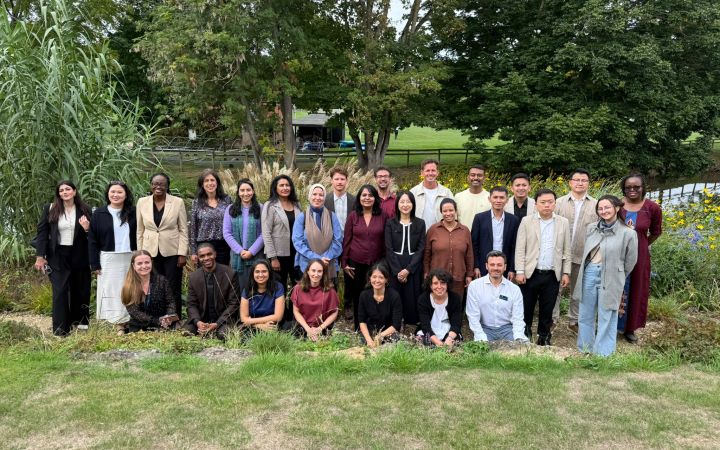
Oxford, United Kingdom – Seventeen senior leaders from government, parliament, business, and social partners across 14 countries gathered at St. Hilda’s College, University of Oxford, from 21 to 23 September for the first edition of Future-Proofing Business and the Economy . The new executive training programme is delivered by the UN Institute for Training and Research (UNITAR), under the Partnership for Action on Green Economy (PAGE), with the Oxford Smith School of Enterprise and the Environment .
Today leaders are increasingly required to make decisions in an environment of growing uncertainty and complexity, faced with multiple transitions, trade disruptions and geopolitical tensions. The programme supported participants in navigating these dynamics, exploring how economies, enterprises and organisations can remain competitive, resilient, and inclusive in an unpredictable and multipolar world – and how leaders can drive that transformation within their own organisations.
The programme combined three weeks of online self-paced modules on Reshaping our Economies with an intensive three-day residential training in Oxford. It brought together the world-leading academic research of the University of Oxford with the policy expertise of PAGE’s five UN agencies – ILO , UNDP , UNEP , UNIDO and UNITAR – providing participants with the opportunity to see how the latest policy and market theory is being applied in countries around the world, including the challenges and opportunities these developments bring.
From emerging trends to tools for implementation
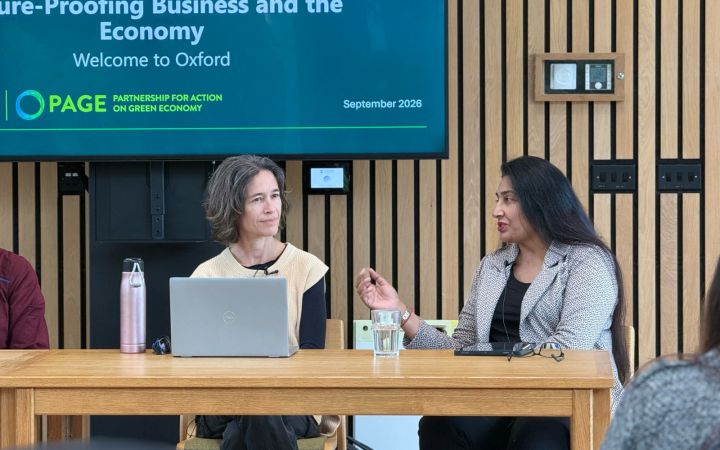
The three-day training was designed to examine the key economic, environmental, technological, and policy forces reshaping our economies – alongside the risks and opportunities these shifts presents for business, government, and society. Through a combination of expert lectures, panel discussions, and interactive workshops, the programme strengthened participants’ capacity to interpret emerging trends, and how to respond to these strategically within both public and private sector contexts.
Day 1 focused on emerging trends and drivers, with sessions exploring emerging climate risks and opportunities, new economic paradigms (including a new “Market Humanism” vision for economic development), how new technologies progress and diffuse, the role of digital technologies in advancing a green transition, and how to future-proof supply chains through green industrial transformation and circular economy models.
Day 2 moved from emerging trends to tools for implementation, with sessions focused on mobilising public finance for a green transition, the design of climate policies, leveraging nature-related markets, developing circular economy business models and strategies, and how to manage labour market transformation. Day 3 centred on leadership, with sessions on developing public or private sustainability strategies, how to track sustainability progress as a key accountability tool and managing emerging climate liabilities.
Participants from around the world shared how difficult it has become to navigate multiple transitions in a context of growing uncertainty. A common conclusion emerged: learning and capacity development cannot be a nice-to-have but are the foundation for informed policy and business choices. – Amrei Horstbrink-Gavillet, Senior Specialist, UNITAR
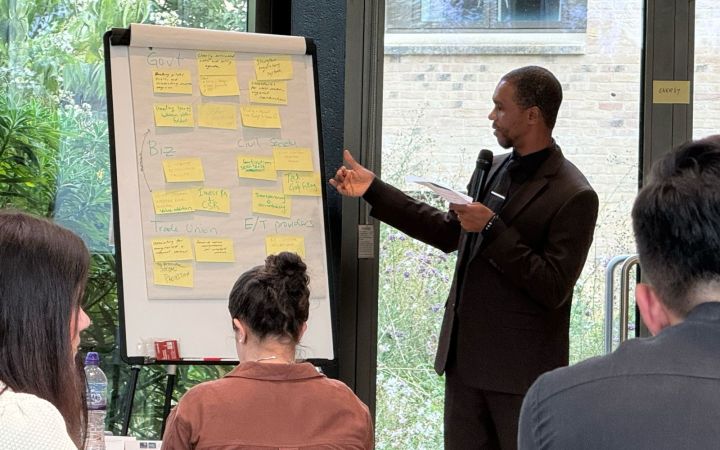
Across the three days, UNITAR also led interactive workshops inspired by the UN Futures Lab’s UN Strategic Foresight Guide, helping participants apply the programme themes to their organisational and policy contexts. Three foresight exercises guided them to map emerging risks and opportunities, develop strategic responses and identify institutional gaps. These culminated in a Leadership Challenge, where each participant committed to a “Future-Proofing Action Plan” with realistic actions for the next 6-12 months.
I applied to this programme to learn how to strengthen evidence-based policy. Learning alongside the UN network was what excited me most about the experience (…). My goal now is to advance LBSNAA’s Net Zero Living Lab, turning our campus into a practical, scalable model of sustainable governance that can be replicated across other institutions. – Mahesh Kumar Devaraja, Deputy Director (Senior) & Director, Centre for Disaster Management, Lal Bahadur Shastri National Academy of Administration (LBSNAA)