For more than a decade, David Putnam and Lawrence Bonassar have been trying to build a better molecular yarn.
The two Cornell engineers set out to recreate lubricin, a slippery glycoprotein that keeps healthy knees, hips and shoulders gliding smoothly against each other for a lifetime. When joints are injured or aged, lubricin production drops, friction rises and cartilage begins to wear away, a process that can end in osteoarthritis, a disease affecting more than 32 million adults in the United States.
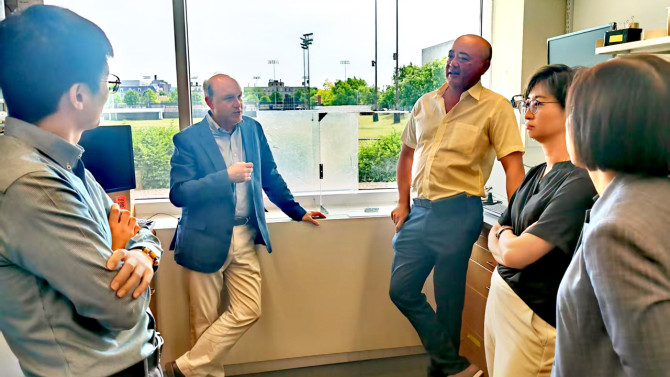
The Pleryon team visited the lab of Lawrence Bonassar (center, in blazer) in 2024 to discuss the technology and applications around lubricin, a slippery glycoprotein that they are using in two human trials, for dry eye and osteoarthritis.
Now their discovery of a lubricin-inspired polymer has not only resulted in a start-up co-founded by one of their doctoral students but is also entering into two separate first-in-human trials. The team aims to give patients a synthetic stand-in for a natural lubricant when the body stops making enough on its own.
The human trials in Australia will test the synthetic lubricin to treat osteoarthritis in knees, and trials in Canada will test it as a remedy for dry eye disease. If successful, the Food and Drug Administration will recognize the innovations as safe and effective and they will potentially become treatment options for sufferers.
“Since the human body has over 300 joints and countless other interfaces, potential uses of this material range from helping muscles and tendons slide past each other to treating TMJ [a painful jaw condition] pain,” Putnam said.
Osteoarthritis affects more than 500 million people worldwide and remains a leading cause of disability in older adults. And according to the American Academy of Ophthalmology, as many as 350 million people suffer from dry eye disease.
The technology’s roots originated in studies out of Putnam’s and Bonassar’s labs at the Meinig School of Biomedical Engineering in the Cornell Duffield College of Engineering. The researchers designed and synthesized a new polymer that matches lubricin’s natural lubricating power on cartilage, and follow-up studies mapped out exactly which parts of the molecule make that possible.
“We had two Ph.D. students, one each, who did the initial prototyping. And then I had a doctoral student, Zhexun “Jason” Sun, who worked on the current material,” said Putnam, the Samuel B. Eckert Professor in Engineering. “He went back home to China and the material became the basis for a new company, Pleryon Therapeutics.”
Sun, Ph.D. ’18, co-founded Pleryon and now is also its chief technology officer.
The polymer works something like a piece of yarn with two sections spliced together, Putnam said. One section is bright with static cling, seeking out and gripping onto tissue such as cornea for dry eye or cartilage and bone for osteoarthritis. The other section is entirely different, built to hold onto water tenaciously. When the polymer anchors itself to a surface, that water-loving half drags a thin film of water along with it, which gives the material its slipperiness.
In this case, architecture, not just chemistry, was the key design insight, said Bonassar, the Daljit S. and Elaine Sarkaria Professor in Biomedical Engineering.
“We have offices and labs next to each other,” Bonassar said. “I saw one of Dave’s students present work he was doing with a plastic surgeon for a different application. We’d already done 90% of the work to find a new lubricant for cartilage – we had molecules that were sucking water, but they didn’t’ stick to the tissue. We needed that extra piece of yarn to fixate the water-binding molecule to cartilage. It’s an odd combination, something sticky that will adhere to tissue, and another domain that is very slippery.”
In the first study, published in 2019 in the Proceedings of the National Academy of Sciences, the team tested the polymer on sections of bovine cartilage that had been stripped of their natural lubricin. The coefficient of friction on the treated cartilage fell from roughly 0.39 to 0.09, a number nearly identical to cartilage treated with real lubricin. When the researchers tried the two halves of the molecule separately, neither one worked. Only stitched together, in a specific order, did the polymer perform.
Because surfaces are never completely smooth, the researchers had to focus on boundary friction, the resistance that occurs when two sliding surfaces are in direct physical contact at microscopic high points.
“One of the tricky things about trying to understand this question is that the amount of friction in our joints isn’t constant,” Bonassar said. “When you’re running down the road, you are moving a lot of fluid across your joints and that helps the friction coefficient be low. Sometimes we are standing still, and that’s when the friction coefficient is highest. The reason we focused on the boundary friction is because that is where the tissue is getting damaged. Reducing that boundary friction was always our target.”
Their second study, published in 2020 in ACS Applied Materials and Interfaces, dug into why the architecture mattered so much. The team built a library of eight versions of the polymer, varying the respective lengths of the water-grabbing section and the tissue-binding section. The binding section turned out to be the deciding factor. Eight amine groups were the outer limit, but somewhere around 24 was just right, enough to anchor the polymer firmly to cartilage without so many that neighboring molecules crowded each other off the surface. Stretch the anchor too long and friction crept back up. The length of the water-holding section, by contrast, barely mattered once it passed a minimum size.
“There was a sweet spot,” Putnam said. “If it’s too long it doesn’t work; if it’s too short it doesn’t work.”
That finding gives future drug designers a simpler recipe: the team’s data suggest engineers can focus most of their attention on the short anchoring segment.
Lubricin has been notoriously difficult and expensive to manufacture at scale, which has kept it largely out of clinics despite years of promising animal studies. A synthetic version that can be produced more simply, and tuned with the precision the research team has now demonstrated, could open a more direct route from lab bench to treatment.
Putnam says collaboration with the College of Veterinary Medicine was critical in advancing their ideas. Cornell as a whole has been instrumental in facilitating this research, with support from Center for Technology Licensing, the Cornell Institute for Biotechnology, and a seed grant through the National Science Foundation, which culminated in a large National Institutes of Health grant, he said. “All the support that is supposed to move things forward worked well.”