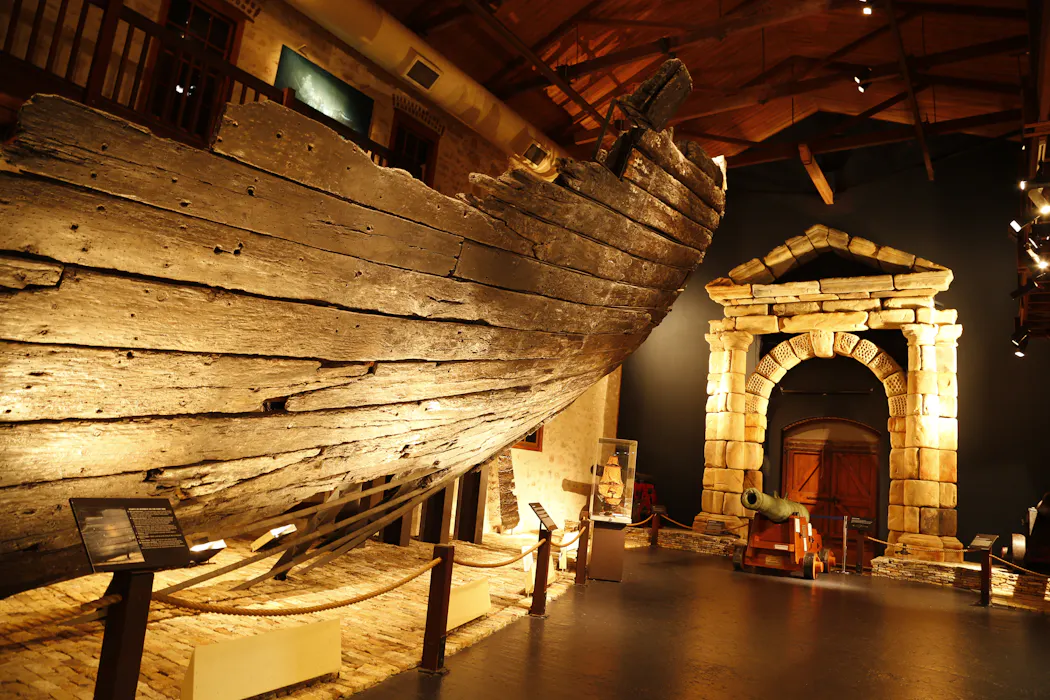
Few episodes occupy a darker place in maritime history than the wreck of the Batavia .
Authors
- Anthony Clarke
Research Fellow, School of Earth and Planetary Sciences, Curtin University
- Chris Kirkland
Professor of Geochronology, Curtin University
Wrecked off the mid-west coast of Western Australia in June 1629, 159 years before the First Fleet entered Sydney Harbour, the disaster offers a stark alternative to romanticised tales of exploration.
Batavia’s story is instead one of greed, mutiny, heroic resistance and mass murder, exposing the violence and ambition that accompanied early European ventures into Australian waters.
The ship’s story is also one of a massive global supply chain – part of which has remained hidden until now. In our new study published in the Journal of Archaeological Science: Reports , we trace the origins of some of the Batavia’s most important cargo: massive sandstone blocks.
The tiny crystal preserved in these rocks help paint a detailed picture of lives, labour and global connections nearly 400 years ago.
An immensely valuable cargo
The Batavia was the flagship of the Dutch East India Company. On its maiden voyage from the Dutch Republic to Java, it carried 341 passengers and crew, together with an immensely valuable cargo.
Among it was what mariners called “paying ballast”. This was heavy material that served two purposes: stabilising the ship and carrying commercial or practical value at its destination.
In the ship’s hold, this included thousands of bricks and large, carefully carved sandstone blocks intended for a monumental gateway or portico in the Dutch East India Company’s colonial capital, Batavia (known today as Jakarta).
During the voyage, junior officer Jeronimus Cornelisz plotted to seize the ship and its treasure. After Batavia struck Morning Reef, roughly 60km west of the modern-day town of Geraldton, Commander Francisco Pelsaert departed in an open boat to seek help.
In Pelsaert’s absence, Cornelisz seized control of the survivors scattered across the nearby islands. He sent Wiebbe Hayes and a group of fellow soldiers to a distant island, expecting thirst to kill them. Cornelisz’s mutineers then began systematically killing the remaining survivors. More than one hundred men, women and children were murdered.
But Hayes and his soldiers found water. Survivors who escaped Cornelisz reached Haye’s group on makeshift rafts and warned them of the killings. They fashioned weapons, built a stone fort, and repeatedly repelled the mutineers. The remains of their stone fort on West Wallabi Island are regarded as Australia’s oldest surviving European-built structure.
When Pelsaert’s rescue ship appeared on the horizon, Hayes raced to reach it before the mutineers. He boarded first and revealed what had happened. The mutiny was over.
Through it all, hundreds of sandstone blocks lay within Batavia’s wreck, silent witnesses to the bloodshed unfolding across the islands. The stones survived; most of the people who sailed with them did not.
Nearly 400 years later, those stones are revealing the extraordinary logistical networks that supplied the Dutch East India Company.
Gaps in the record
At the dawn of global capitalism, the Dutch East India Company created one of the richest corporate archives of the early modern world.
Yet even its meticulous records have gaps. We know the Batavia carried a prefabricated stone portico. But we don’t know precisely where the stone came from or how materials from different quarries were assembled into a single overseas shipment.
To investigate, we examined Batavia’s sandstone cargo, now held by the WA Shipwrecks Museum. The blocks looked remarkably similar to each other, and centuries beneath the waves changed more obvious clues to their origins, such as colour, mineralogy, and the cement that holds the sand grains together.
To understand their source, we therefore turned to a more durable record hidden within the rocks. Sandstone carries tiny crystals known as zircon , often eroded from many older rocks.
Each grain contains a uranium-lead clock that records when the crystal grew. Together, their ages create a distinctive geological fingerprint of the ancient landscapes that supplied the sand.
Comparing geological fingerprints
We compared the geological fingerprints of the Batavia portico blocks with sandstone from German quarries known to have supplied building stone to the Netherlands during the 17th century. Some of these quarrying and trade networks had much deeper roots, extending back to Roman times.
The fingerprints revealed that similar-looking blocks came from different sources. One matched Bentheim sandstone; the other matched Obernkirchen sandstone.
Both zircon fingerprints were strikingly different.
Bentheim blocks contained abundant 3-billion-year-old zircons derived from ancient rocks in Scandinavia, whereas Obernkirchen blocks are richer in younger zircon, eroded from the 300-million-year-old Variscan mountain belt to the south, in what is now central Germany.
The quarries are about 140km apart and connect to different river systems. The stones travelled through separate inland transport networks before converging at a Dutch East India Company hub, most likely Amsterdam, where they were shaped and assembled into a single shipment for Batavia.
Numbers carved into the blocks acted as assembly marks , a 17th century precursor to flat-pack instructions.
No surviving document records this precise journey. But geology exposes a sophisticated and coordinated supply chain linking quarry workers, stone cutters, river transporters, merchants, and sailors across northwest Europe.
More than decorative cargo
Batavia’s portico blocks are a testament to the infrastructure of an empire: European stone gathered, standardised, and shipped across the world to build the Dutch East India Company’s colonial headquarters in Java.
Nearly four centuries later, the blocks show that stories can indeed be written in stone, recovering traces of networks of labour, trade and human connection.


/igwg-meeting-2026.tmb-768v.jpg?sfvrsn=6a4c8616_1)