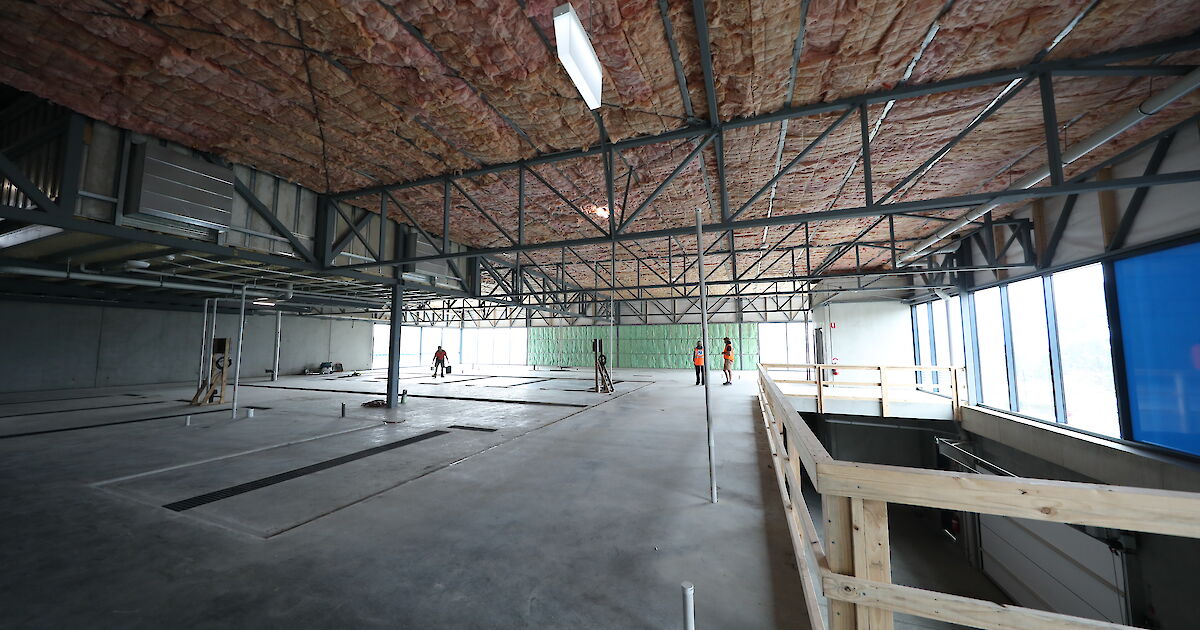
Work is about to begin on the interior fit-out of a new state-of-the-art krill research facility in Taroona, on the outskirts of Hobart.
The Dr Isobel Bennett Southern Ocean Research Aquarium (SORA) will house a world-leading aquarium system for the conservation and management of Antarctic krill and other Southern Ocean species, which are critical to Southern Ocean ecosystems and food security.

Photo: Simon Payne
SORA is owned and operated by the Australian Antarctic Division and is co-located with the University of Tasmania’s Institute of Marine and Antarctic Studies (IMAS) fisheries research facility. The SORA exterior is complete and work will soon begin on installing nine small research aquaria rooms and six larger rooms, each room capable of housing experimental research systems containing 3,000 litres and 8,000 litres of water respectively.
“That’s five times the volume that our current facility can hold so it’s a massive step-change in our capacity,” Project Manager Andrew Thompson said.
“The capabilities of the new facility far exceed anything even our krill experts could have hoped for.
“Temperature-controlled seawater (-1.5°C), replicating natural Southern Ocean conditions, will be supplied to all research rooms.
“Researchers will have the flexibility to modify temperature and other water quality parameters including pH within individual rooms, significantly enhancing the facility’s capability to advance research on ocean acidification and the resilience of krill larvae and other Southern Ocean species.”
SORA will also have a -30°C sea ice research freezer, allowing researchers to grow sea ice in situ and study how the krill underneath interact with the ice and phytoplankton – microscopic ocean organisms that are krill’s primary food source.
“That will be a world first,” Mr Thompson said.
“There’s only one other research freezer like it in the world, and it’s used for physical and chemical water – ice – atmosphere research rather than the biological aspect.”
Phytoplankton will be grown on site in a dedicated phytoplankton culturing facility, producing high volumes of quality feed for the krill.
Another two storey-high, 50,000 litre tank will be temperature controlled to -1.5°C, allowing researchers to test equipment and study how krill swarms behave.
From ship to SORA
The new facility, combined with RSV Nuyina’s wet well, will revolutionise krill handling practices for research.
Historically, krill were brought on board Australian icebreakers by net, damaging up to 90 per cent at a time. (Nuyina’s wet well, which draws the animals directly inside the ship, has already reduced this to around 5 per cent).
Containers were then trucked from the port to the Australian Antarctic Division’s krill labs in Kingston, where researchers moved them into tanks by bucket.
When SORA is operational, trucks will still be used to transport containers from the ship to Taroona, but the age of the bucket will be over.
“Once the containers pass biosecurity they’ll come in by flatbed truck and then be connected to the side of the building via what we’re calling umbilicals,” Mr Thompson said.
“They’ll recirculate cold filtered sea water and reestablish life support to those animals and it’ll be continuously monitored by the facility’s alarm system that will immediately alert staff to any temperature fluctuations.
“The animals can be decanted and spread out through the facility in a structured manner.”
Energy efficient.
Both SORA and the University of Tasmania’s The Ocean teaching facility at the IMAS site have been built with energy efficiency as a priority.
Saltwater, rather than air, is being supplied to water cooled chillers serving both the heating, ventilation and air conditioning system (HVAC) and primary aquarium infrastructure.
By using seawater-cooled technology, the facility achieves approximately 40 per cent lower energy consumption than traditional air-cooled alternatives.
Krill are kept in conditions that replicate the Antarctic Southern Ocean, at a temperature of -1.5°C to 0.5°C.
Instead of discarding heat generated during the chilling process, mechanical systems harness and repurpose this energy to contribute to critical heating biological filtration systems and space heating, significantly improving overall energy efficiency and reducing carbon impact.
Aquaria plant and equipment have been centralised to reduce the impact of noise and vibration on the krill and to make access safer and easier for technicians.
All engineering and architectural work at SORA has been completed by Tasmania-based businesses.
The SORA facility fit out will start in November 2026 and is expected to take a year to complete.