What the research is about
Most materials expand when heated. But some materials do the opposite: they shrink as their temperature rises. This unusual property is known as negative thermal expansion. When such materials are mixed with other materials, they can offset ordinary thermal expansion, helping to prevent tiny changes in size or position in precision instruments and other devices.
Among known safe and non-toxic materials, BiNi1-xFexO3 (BNFO) shows the largest negative thermal expansion. BNFO contains bismuth, nickel, iron, and oxygen. However, it has been difficult to make. In the conventional process, a starting material composed of several different crystals had to be heated to about 950°C. During this process, the elements gradually moved from one particle to another and reacted. Before the desired crystal was finally formed, the reaction passed through several intermediate materials-in other words, it took a rather roundabout route.
There were other problems as well. Preparing the starting material produced nitrogen oxides, which can have a harmful environmental impact. In addition, BNFO must be strongly oxidized during synthesis, so a powerful oxidizing agent that is also used as an ingredient in explosives had to be added. This created a risk of the reaction mixture being expelled during synthesis and also required an extra washing step afterward to remove the oxidizing agent. These issues made large-scale production difficult.
Why this matters
To overcome these challenges, a research team led by Specially Appointed Assistant Professor Takumi Nishikubo of the Institute of Science Tokyo (Science Tokyo) looked beyond the usual factors such as heating temperature, heating time, pressure, and the surrounding gas conditions. Instead, the researchers focused on the state of the starting material before heating.
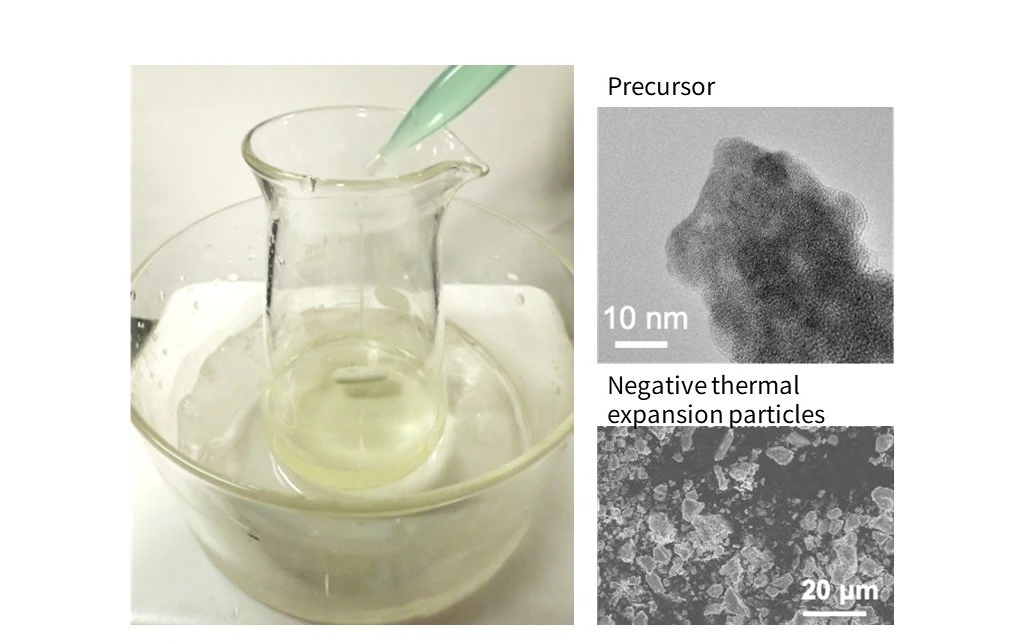
They developed a new precursor in which bismuth, nickel, and iron are uniformly mixed at the atomic level. Like glass, this precursor does not have an ordered crystal structure. The researchers also supplied oxygen during the solution-based preparation process, placing the bismuth and nickel in oxidation states that make it easier for the desired material to form.
As a result, the target crystal appeared directly at 750°C without passing through several intermediate materials, and crystallization was completed in less than one minute.
In the conventional method, high temperatures and long reaction times were needed to break down existing crystal structures and rebuild them into a new one. In the new method, the elements are already dispersed in a disordered, non-crystalline state before heating. This allows the material to take a much shorter route to the final crystal structure.
Shortening the heating time also helped suppress particle growth. The researchers reduced the particle size from about 15 micrometers to about 5 micrometers. Importantly, the smaller particles retained the same degree of shrinkage while showing negative thermal expansion over a wider temperature range.
What’s next
The new method avoids the nitrogen oxide emissions that were a problem during conventional precursor preparation and does not require any additional oxidizing agent during the final synthesis step. This could lead to safer production with a lower environmental impact.
The researchers have also found that a similar approach can be used not only for negative thermal expansion materials, but also for superconducting materials, which can show zero electrical resistance at low temperatures. This suggests that the method could be useful for producing a wider range of materials.
In the future, fine particles of negative thermal expansion materials could be mixed into resins and other materials to create composites whose size changes very little with temperature. The same strategy may also be applicable to other materials with oxidation states that are difficult to achieve by conventional methods.
Comment from the researcher
In ceramic materials research, we often try changing the temperature, heating time, pressure, or surrounding gas conditions. In this study, however, we were able to eliminate the ’roundabout route’ to the desired crystal by preparing the starting material so that it could react more readily before heating.
The idea came from combining a method for mixing the elements uniformly with a method for supplying oxygen from solution, allowing us to create an atomically disordered state similar to glass. I believe my time in the United States encouraged me to think more freely and helped inspire this approach. I hope to continue using this kind of flexible thinking to tackle the synthesis of other materials that have been difficult to make.
(Takumi Nishikubo, Specially Appointed Assistant Professor, Institute of Integrated Research, Institute of Science Tokyo)
Dive deeper
Related research by Azuma-Yamamoto Group
Explore more research in Science for All
Science for All showcases cutting-edge research at Science Tokyo and highlights the ideas, people, and possibilities shaping the future.

Follow Science Tokyo research on X
Our Research Frontiers account features selected stories from Science for All and regularly shares research from across Science Tokyo.