
Christopher Nolan’s highly anticipated adaptation of The Odyssey officially opened in theatres this week. It retells Homer’s ancient epic of Odysseus’ journey home from the Trojan war.
The Trojan war of Homer’s epics is heavily mythologised . But it is set in a world of seafaring and sea passages that the ancient Greeks knew intimately well.
Interestingly, Nolan’s film has reframed the Trojan war as a trade war over a shipping route. This economic motive is absent from Homer’s original.
But it would have been a highly relevant theme for the Athenians listening to the Homeric epics hundreds of years later, when actual wars hinged on control of a vital shipping route to the Black Sea, passing right by where Odysseus began his mythological journey home: the Dardanelles.
Controlling this waterway – including tolling the ships that traversed it – was crucial to the rise of the Athenian Empire. That has parallels with – and lessons for – today , when placing tolls on crucial shipping routes is again being debated.
A gateway to the Black Sea
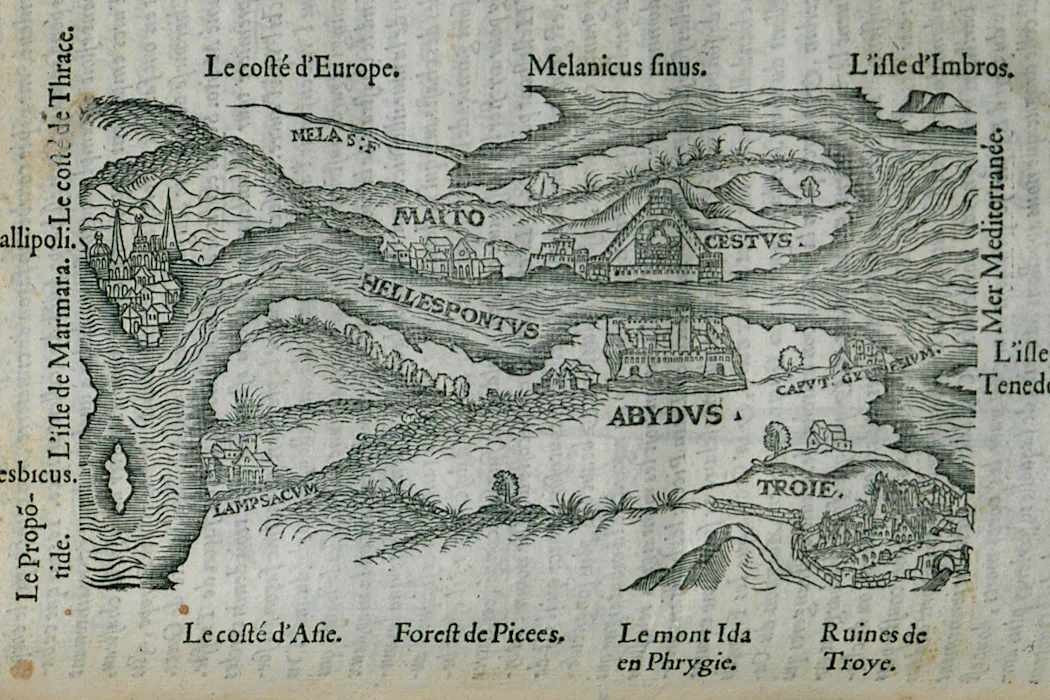
The Dardanelles (which the ancient Greeks called Hellespont ) is a narrow natural strait situated in modern-day Turkey.
Along with the Sea of Marmara and another strait to the north-east called the Bosphorus, it connects the Aegean Sea (and therefore the Mediterranean Sea) to the Black Sea.
From about 500 BCE, the Greek city-states, but especially democratic Athens, began to realise that control of this waterway was crucial to their survival and success.
A couple of decades later, the Persian wars had only reinforced this realisation because Xerxes, the great king of the Persian Empire, had built a pontoon bridge across the Dardanelles to get his invading army into Greece.
After the Greeks defeated Xerxes in the Balkans in 480 and 479 BCE, one of the first things they did was to secure the Dardanelles and capture other cities to its north in what is now Turkey, especially Byzantium (Istanbul today) and Chalcedon (now Kadıköy).
At the same time, the Athenians, who were now leading the Greek coalition against Persia, also captured three big islands on the approach to the strait: Imbros, Lemnos and Skyros.
This made it safer for their warships and grain ships to traverse the shipping route from Athens to the Dardanelles.
Feeding an empire
Securing this shipping route was soon about more than just warfare. It also allowed the Athenians fully to exploit the trade coming from the Bosporan kingdom, which covered roughly modern-day Crimea and parts of southern Ukraine.
Greece’s climate and terrain were well suited to some crops, and Athens was completely self-sufficient in olive oil. But very dry Attica especially was poorly suited to others – notably grain – so trade with the north was vital to fuelling its rise.
Controlling the Dardanelles and hence the shipping line to the Black Sea allowed the Athenians to secure enormous amounts of cheap food, leading to a huge population boom.
By 431 BCE, the Peloponnesian War broke out between Athens and Sparta.
At this point , we know Athens was importing two thirds of its food from overseas, and the bulk of it through the Dardanelles.
Sparta and its allies invaded the territory of Athens repeatedly during the first ten years of this storied 30-year war. In response, the Athenians simply withdrew their population behind their fortifications and relied on the grain coming through the Dardanelles to keep them alive.

Tolls on shipping
In the last ten years of the Peloponnesian War, when Athens started to run out of money, it actually became more heavy-handed in its control of this vital narrow waterway.
Athenian democracy had long had garrisons on either side of the Bosphorus to police what the other Greek city-states were importing through this shipping route.
But, in 413 BCE , it introduced a 10% toll on the value of all cargo passing through this strait. The enormous amount of money this toll raised helped Athens hold out against Sparta for another seven years.
How losing control crushed Athens
However, the Spartans ultimately won the Peloponnesian War. In its final decade, they struck a deal with the Persian Empire to build a fleet to challenge Athens at sea.
In 405 BCE , very close to modern-day Gallipoli, the Spartan fleet captured almost the entire last fleet of Athens without a battle – close to 200 ships – and executed the captured Athenian sailors.
Without any fleet, Athens lost control of the shipping line and the Spartans stopped the grain ships sailing to Athens from the north.
Athens was quickly starved into submission through a land and sea blockade, and ultimately lost the Peloponnesian War. Losing control of that vital narrow waterway near ancient Troy had thus resulted in the fall of the Athenian Empire.
The pattern repeats
Christopher Nolan’s film is poignant and timeless lesson about the human costs of war and how waging it should be an absolute last resort.
But the ancient history of the narrow waterway on which Troy was situated also holds lessons for understanding the current war between the United States and Iran.
The history of the Dardanelles warns us that states and empires can rise and fall over who controls such a waterway. Prudent states – such as democratic Athens – secure such straits over generations, using all the tools in their diplomatic and military tool kits to do so. To imperil free trade through such waterways or to act recklessly in relation to them can come at a terrible cost.







.jpg)