When a glass of red wine arrives at the table, most drinkers make a snap judgment before taking a sip. Is the color deep enough? Does the hue suggest quality, or raise a red flag?
For years, that visual scrutiny has posed a challenge to an emerging category of wine grapes. Interspecific hybrid varieties – cultivars bred by crossing multiple Vitis vinifera species to withstand disease, cold and the mounting pressures of climate change – have been viewed with skepticism by winemakers and sommeliers who worried that the wines they produce simply don’t look the part.
New research from Cornell suggests those concerns may be overblown.
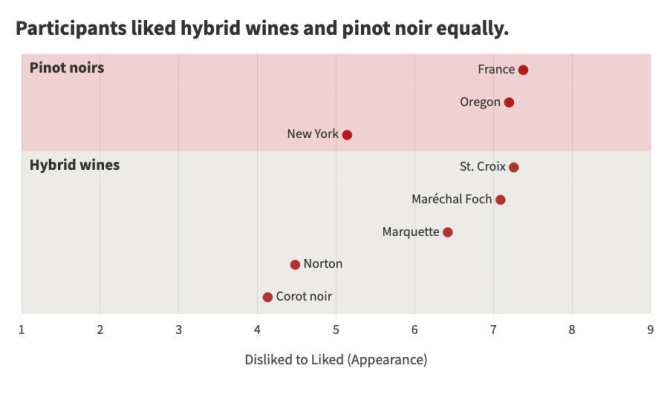
A study published Sept. 23 in the American Journal of Enology and Viticulture by researchers at Cornell Agritech and the Université Bourgogne Europe in Dijon, France, found that consumers showed no consistent bias against the color of wines made from hybrid grape varieties. When evaluated alongside pinot noirs from Burgundy, Oregon and the Finger Lakes, several hybrid wines ranked among the most visually appealing in the study – and color, regardless of variety, turned out to be a weak predictor of whether drinkers actually enjoyed what was in the glass.
“This has been something bugging me for a long time,” said Anna Katharine Mansfield, associate professor of enology at Cornell AgriTech in the College of Agriculture and Life Sciences. “Prior to coming to Cornell I worked with breeders at the University of Minnesota and often there was this idea that consumers would reject a wine if its color didn’t look very Vitis vinifera-like. But no one had ever studied that question.”
Additionally, the research was motivated by chemistry, according to co-author and food science doctoral student Catherine Dadmun.
“Especially in Europe, there are historic restrictions on the chemical color compounds that appear uniquely in hybrid grapes,” Dadmun said. “This has led to the assumption that these compounds must result in low-quality color. We were trying to clarify what is and isn’t important for consumer perception of color quality from a chemical composition standpoint.”
As winemaking regions across North America and Europe grapple with more erratic weather, late frosts and increasing fungal disease pressure, hybrid cultivars offer a compelling alternative to the European grapes that have dominated fine wine for centuries. Varieties like marquette, Maréchal Foch and St. Croix can be grown with far fewer pesticide applications and survive winters that would devastate conventional vineyards. But commercial adoption has been slowed by persistent doubts about whether consumers will accept the resulting wines.
To test one of those doubts directly, the research team recruited 82 regular red wine drinkers through the Cornell Sensory Evaluation Center and asked them to evaluate eight commercial red wines, five made from hybrid cultivars sourced from New York, Wisconsin, Tennessee and Iowa, plus pinot noirs from three regions, without knowing which was which. Panelists rated how much they liked each wine’s appearance, how much they expected to enjoy it based on color alone, and then, after tasting, how much they actually liked it.

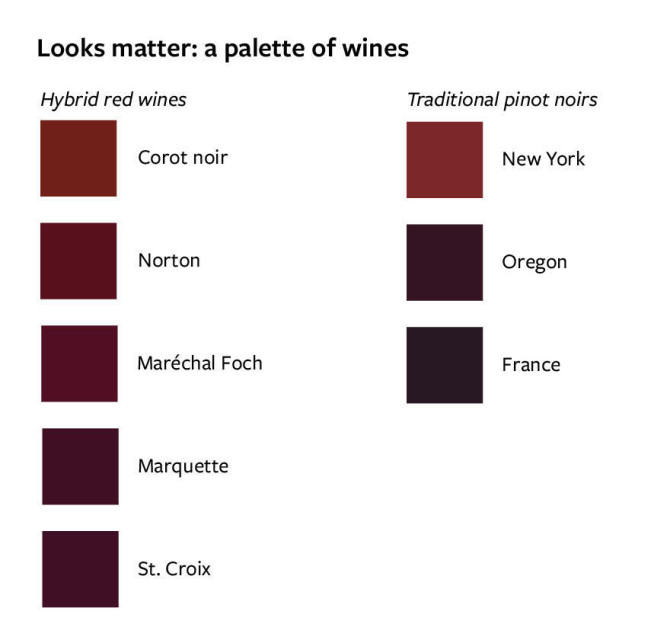
The results cut in two directions at once. Color did matter, but mostly as a prelude. Wines that appeared lighter or showed more yellow and brown tones scored lower for visual appeal and generated weaker expectations. Three wines clustered at the bottom of the visual rankings: a Finger Lakes pinot noir, Norton from Tennessee and corot noir from near Albany, New York. But when panelists tasted all eight wines, color’s predictive power largely evaporated. The statistical relationship between appearance liking and actual liking explained only about 8% of the variation in drinkers’ responses.
“The fact is, taste and aroma are so much more important than color in overall quality perception,” Dadmun said. “When we evaluated hue-liking and overall appearance-liking, the pinot noirs and hybrid grapes were largely in the same pool.”
The finding holds an implicit challenge to wine industry assumptions.
Darker wines have long been associated with higher quality, a bias that has made some winemakers reluctant to promote hybrids. But the Cornell data showed no meaningful correlation between color intensity and actual liking. What seemed to drive the lower visual scores for the three least-liked wines wasn’t lightness per se, but a tendency toward brownish, yellow-tinged hues rather than the deep red-purple that consumers associate with a young, well-made red.
“Another thing to bear in mind with color evaluation is you’re frequently doing this in the glass, not the bottle,” Mansfield said. “You’re rarely buying wine in a clear glass bottle because green glass is more protective, so color is a non-issue in some ways. My hope is that people breeding hybrids can just worry less.”
The researchers also conducted detailed chemical analysis of 17 wines, mapping the anthocyanin profiles – the pigment compounds responsible for red wine’s color – of both the sensory wines and additional hybrid samples. Hybrid grapes contain different types of anthocyanins than vinifera varieties, including compounds called diglucosides that are less deeply colored and may be slightly more prone to browning over time.
The analysis confirmed that hybrids do carry a broader range of anthocyanin structures. But consumer preferences didn’t track the chemistry the way winemakers feared. Wines with high proportions of diglucoside anthocyanins – like St. Croix, which ranked among the most visually appealing in the study – performed as well as or better than some traditional wines. St. Croix and Burgundy pinot noir, which contains no diglucosides at all, tied for the highest overall appearance scores.
The study was supported by the New York Wine and Grape Foundation and included wine samples from commercial producers in five states, with contributions from Wollersheim Winery and Vineyards in Wisconsin and Liberty Vineyards in New York. Instrumental color analysis was conducted at Cornell AgriTech, while anthocyanin profiling using ultra-high-pressure liquid chromatography was performed in Dijon in collaboration with co-authors Natalia Quijada-Morin and Régis D. Gougeon.
The researchers note that the study has limits. Commercial wines vary in ways that are difficult to control: vintage conditions, winemaking techniques and vineyard practices all shape color independently of grape variety. Future research, they suggest, should examine how hybrid wine color evolves with age, and whether consumer perceptions shift as wines made from these cultivars become more widely available.
“We hope growers and producers will be more open and worry less about whether a hybrid looks like a vinifera wine or not,” Mansfield said. “We want them to focus instead on the parameters of what makes a good wine.”