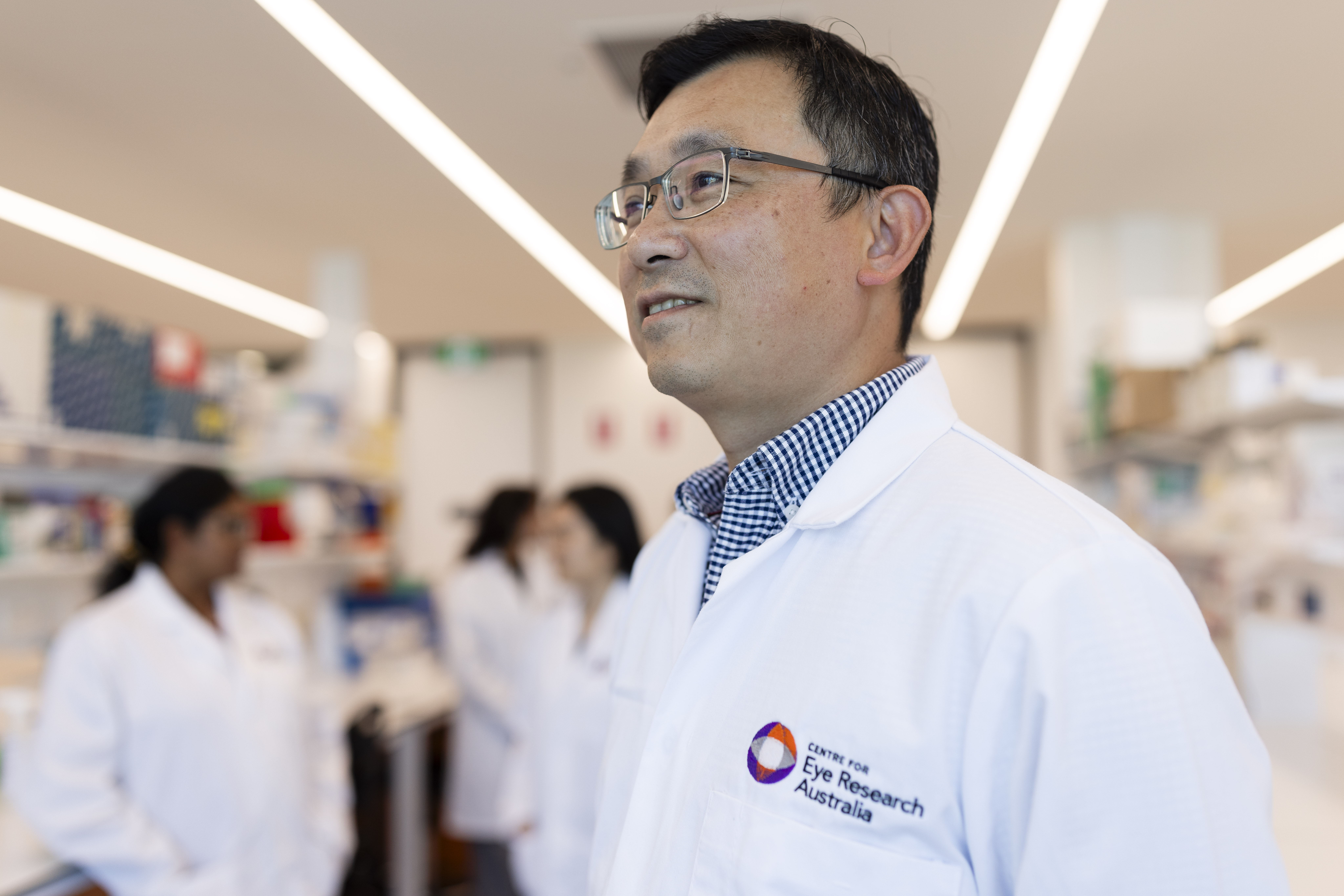
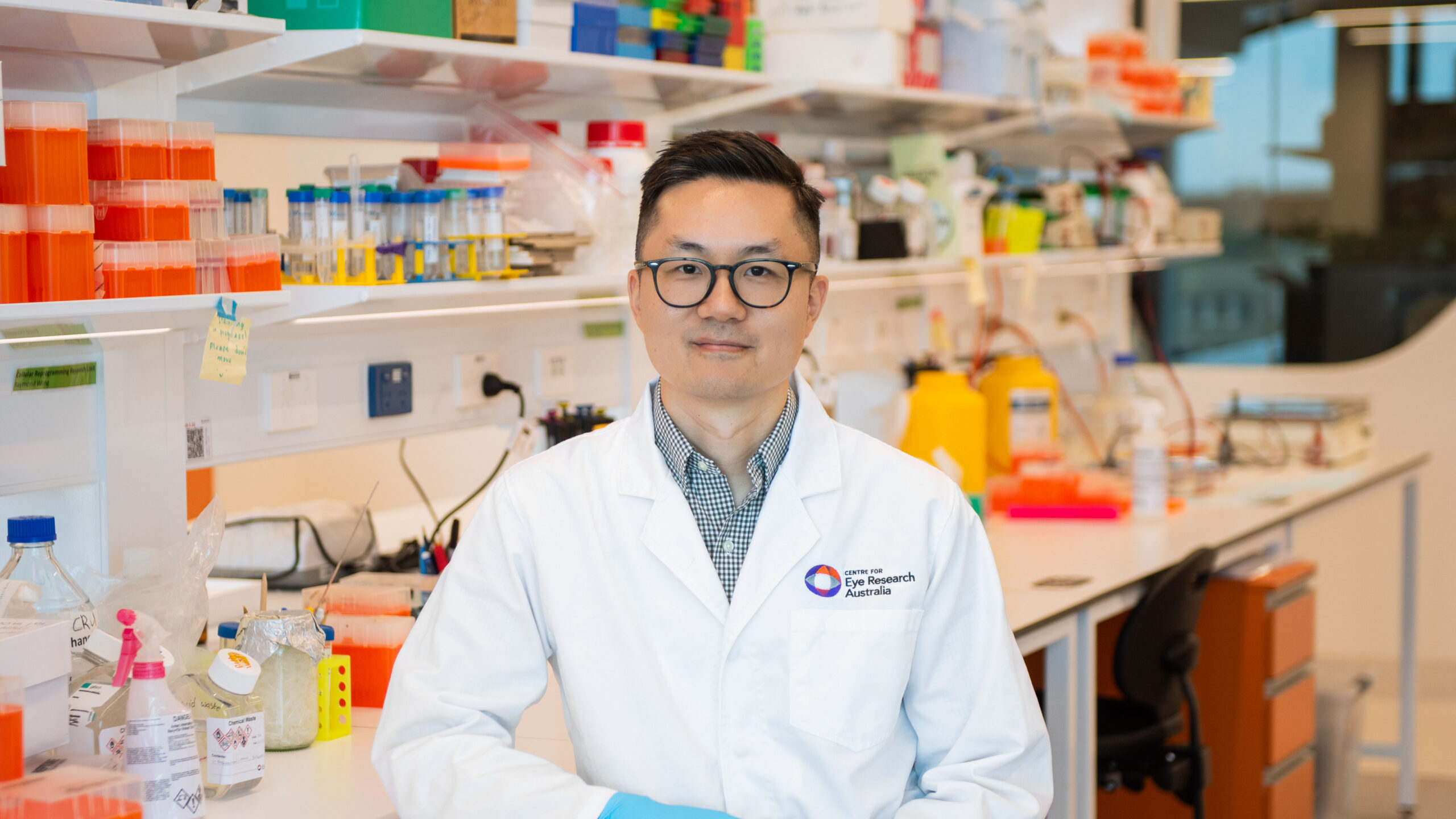
CERA’s Head of Genetic Engineering Research Professor Guei-Sheung (Rick) Liu is taking a new approach to help make sight-saving treatments available to more people. He has founded CERA’s newest spin-out company, Adara Bio, to translate his RNA editing research from the lab towards the clinic and develop precision treatments for a broad range of inherited retinal diseases (IRDs).
“Rather than developing every treatment from scratch, which is slow and costly, Adara Bio aims to build an adaptable platform to treat many different IRDs,” Professor Liu says.
The technology has the potential to speed up treatment development and help reach patients faster, including people living with some of the rarest inherited retinal diseases.
Changing the message
Most of the gene therapies currently available work by replacing a faulty gene with a healthy copy. The healthy gene is delivered to the eye using a viral vector – a modified virus that safely carries the treatment to the target cells.
One of the biggest challenges is that some disease-causing genes are too large to fit inside the viral vectors used to develop gene therapies. Conditions caused by these larger genes, such as Usher syndrome type 2A, require a different approach, and Professor Liu and his team are addressing this challenge through the development of an RNA editing platform.
While DNA acts as the body’s instruction manual, RNA carries those instructions to cells. With a single dose, the treatment is designed to correct faulty RNA messages so cells can function correctly, helping to prevent vision loss.
Because the treatment works at the RNA level, it does not alter a person’s DNA. The platform is also compact enough to fit within the viral vectors already used clinically in eye therapies.
“The reason we’re starting with Usher syndrome type 2A is that it is caused by a very large gene, and there is currently no way to treat it using a traditional gene therapy approach,” Professor Liu says.
The EDITRA platform has also been designed to be adaptable, making it possible to develop treatments for many other inherited retinal diseases caused by large genes.
“If we can use the platform to treat Usher syndrome type 2A, we can modify it to treat many more of these conditions,” Professor Liu says.
“This approach is faster and more efficient than developing treatments one disease at a time, and we hope it will help bring therapies to a much wider range of people living with inherited retinal diseases.”
The technology has already been tested in eye models, and the team is now working towards an eventual clinical trial.
To help accelerate its path to patients, Professor Liu founded Adara Bio in collaboration with ophthalmology company Medic Vision AI. Medigen, a publicly listed Taiwanese pharmaceutical company, is a major shareholder of Medic Vision AI.
“We hope this means that we can accelerate the development of our work towards a treatment for Usher syndrome 2A, as well as eventually many more conditions,” says Professor Liu.
Double your impact through our Matched Giving campaign.
In our latest edition, we celebrate 30 years of CERA and explore inherited retinal diseases and the research bringing treatments closer.