Three Years on from the Disability Royal Commission: Restrictive practices must be eliminated
Three years after the Disability Royal Commission, People with Disability (PWDA) is urging all Australian governments to commit to eliminating restrictive practices and set out nationally consistent plans for how they will get there.
While the Disability Royal Commission (DRC) recommended stronger authorisation controls and oversight, PWDA believes better regulation alone is an insufficient end goal.
Restrictive practices – including physical, chemical, mechanical, environmental restraints, and seclusion – are regarded by PWDA as a form of legalised, institutional violence that is applied against people with disability on a discriminatory basis.
The Disability Royal Commission recommended immediately banning some restrictive practices, including using seclusion on children and punitive restraints, and introducing stronger rules for when and how others can be used. However, its final recommendations stopped short of calling for the elimination of all restrictive practices.
PWDA believes elimination must be the ultimate destination.
The alarming scale of both authorised and unauthorised restrictive practices shows why greater action and reform is needed.
According to Productivity Commission reporting, the NDIS Quality and Safeguards Commission received 2,305,071 notifications of incidents involving unauthorised restrictive practices in 2024-25. During the same year, 12,439 NDIS participants were subject to at least one unauthorised restrictive practice, up from 11,358 the previous year.
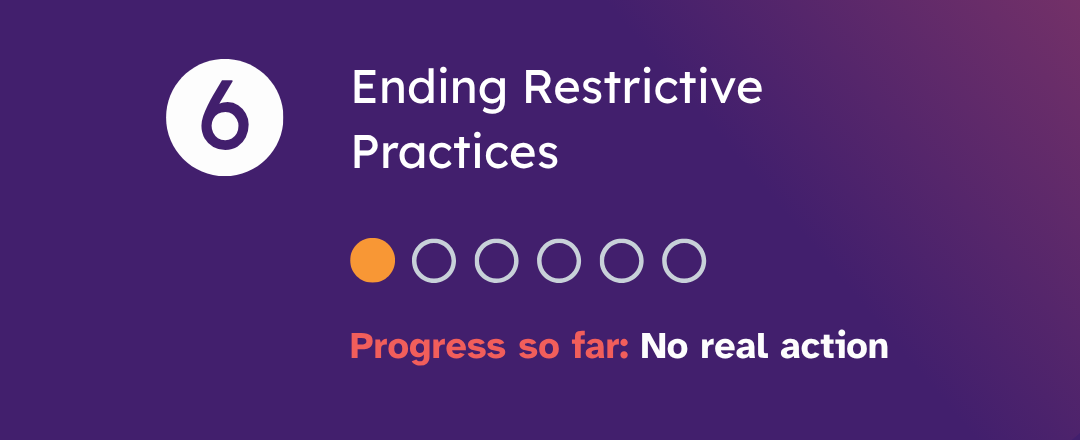
For PWDA, authorising a restrictive practice does not make it safe or remove the harm it can cause.
PWDA Acting CEO Megan Spindler-Smith said governments need to focus on preventing restrictive practices from being used in the first place.
“Restraint, seclusion and other restrictive practices do not stop being harmful because the right paperwork has been completed,” Spindler-Smith said.
“We need to invest in the supports, communication, environments and workforce that prevent restrictive practices from being used in the first place, with elimination as the goal.”
University of Sydney Associate Professor, Dinesh Wadiwel, argues that the use of restrictive practices constitutes legally authorised violence against people with disability – violating multiple international human rights treaties.
“These are forms of violence that would otherwise be treated as assault, but our law by exception treats people with disability in discriminatory ways that basically treats them as not having the same rights as other humans,” he explains.
Associate Professor Wadiwel was a co-author of Restrictive practices: A pathway to elimination, research commissioned by the Disability Royal Commission.
The research set out a pathway to elimination, including making restrictive practices illegal, changing attitudes towards disability, addressing segregation and institutionalisation, recognising the autonomy and leadership of people with disability and investing in trauma-informed support and independent living.
But the Disability Royal Commission’s final recommendations did not go as far as the commissioned research.
“Our strong recommendation was that regulation wasn’t a pathway towards elimination. And that’s because we couldn’t find evidence that regulating restrictive practices actually led to their reduction.
“[The DRC’s] recommendations were useful but weren’t as dramatic or radical as I would have imagined. In the space of restrictive practices, this was one example where the Royal Commission failed to take a strong human rights based stance,” he says.
For PWDA, eliminating restrictive practices also means changing the conditions that allow them to be used in the first place.
This includes looking at why restrictive practices are being used, how their use is investigated and what support is provided to people who experience them.
It also means changing how so-called “behaviours of concern” are understood.
Behaviour can be a way of communicating distress, trauma or an unmet need, or a response to an inaccessible or difficult environment. It should not automatically be treated as a reason to restrain or control someone.
Instead, services should focus on understanding what a person is communicating and providing the right support, communication and environment, while respecting their autonomy and dignity.
Meaningful reduction requires more than changing individual services. Governments need to invest in the workforce, housing, supports and environments that make it possible to prevent restrictive practices from being used.
PWDA has also argued that legislative models designed to regulate restrictive practices-such as the framework reviewed by the NSW Department of Communities and Justice-risk leaving significant gaps by focusing primarily on NDIS participants and NDIS-funded service providers and not adequately embedding reduction and elimination in such frameworks.
People with disability can experience restrictive practices in many settings, including disability services, health and mental health services, schools, justice settings and their own homes. They should not be subjected to restrictive practices or not be covered by appropriate regulations simply because of where they live or which system is providing their support.
In its submission to the NSW Government, PWDA raised the alarm that a person personally consented in only 4.3 per cent of authorised restrictive practice cases.
For PWDA, the fact that personal consent occurs infrequently is not a reason to give it less weight. It is a reason to provide people with disability with more support to participate in decisions about their lives and express their will and preferences when it comes to restrictive practices.
Changing legislation is essential, but Associate Professor Wadiwel said eliminating restrictive practices will also require broader social and cultural change.
“Something we pointed out [in the DRC] is that… transformative human rights change can’t be driven by law alone. It needs to be driven from the ground up through social and cultural change,” he said.
He said the evidence gathered by the Disability Royal Commission provides an important foundation for that continuing advocacy.
“As a public inquiry process, the Royal Commission provided a really useful basis for lots of future advocacy and that includes all the public testimony that people with disability gave… even if they don’t meet our aspirations, they become useful bases for future work.”
PWDA is calling on the Federal Government to take a national leadership role in progressing that future work by supporting state and territory governments and federal agencies, including the NDIA, to drive the reduction and eventual elimination of restrictive practices.