Novel framework enables fine control over the intensity and expressiveness of AI-generated human motion, as reported by researchers from Science Tokyo. The “Motion Style Slider” framework enables animators to control the style and adjust a virtual character’s motion, from subtle to overly exaggerated, based on only two motion samples. The proposed approach achieves consistent style control and smooth transitions without the need for extensive motion-capture datasets.
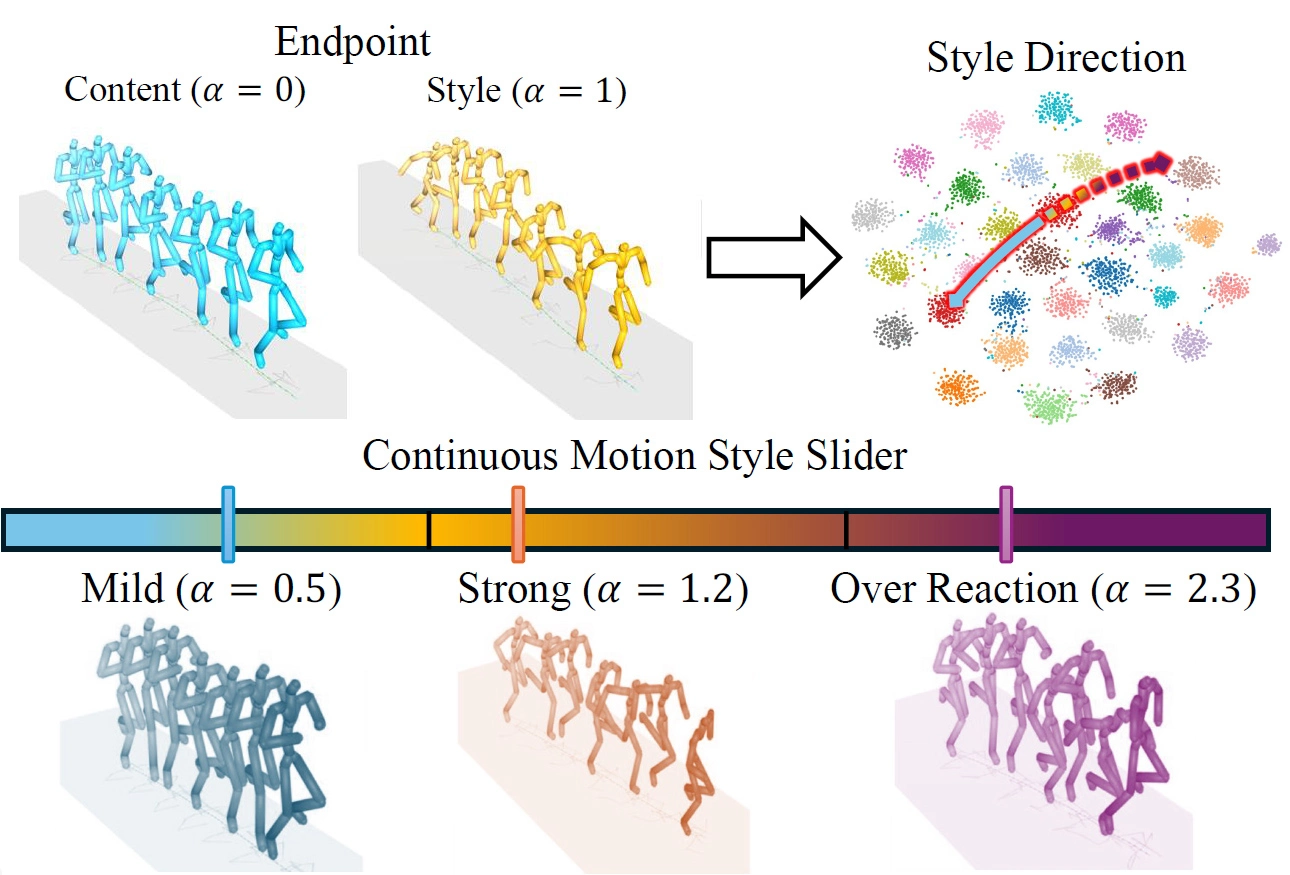
Using a neutral motion and a stylized motion as inputs, the system continuously controls the strength of the style by varying the slider value α.
In the production of videogames and animated movies, directors and animators are constantly fine-tuning how a character’s movements should appear. In many cases, the directors require subtle changes, such as making a character appear a little more restrained or a bit more expressive, and subjectively communicate the degree or extent to which the change needs to be applied. Commercially available artificial intelligence (AI) tools can generate stylized animations for virtual characters, transforming a neutral motion into one that conveys particular styles like joy, anger, exhaustion, or confidence. However, a more refined modulation demands more than simply applying a style; it requires precisely controlling how much of that style comes through.
Most existing tools fall short in this regard, offering only fixed versions of a given emotion or expression with no way to increase or reduce the intensity. The main reason behind this is that AI-based motion-generation systems are often trained using fixed examples of the same action, namely a neutral motion and fully stylized versions obtained through motion-capture technology. Creating additional recordings at multiple intermediate levels of expression would require multiple long motion-capture sessions, making it costly and impractical for real-world production.
To address this problem, a research team comprising Specially Appointed Assistant Professor Chen-Chieh Liao and Professor Hideki Koike of the School of Computing, Institute of Science Tokyo (Science Tokyo), Japan, together with researchers from Cygames, Inc., Japan, has developed the Motion Style Slider, a new AI framework for continuous control of the motion styles intensity in generated human animation. Their work was presented at the European Conference on Computer Vision 2026 (ECCV 2026) held on September 10, 2026.
The proposed framework needs to learn from only two endpoints: a neutral motion and a stylized version of the same action, such as ‘neutral walking’ and ‘happy walking.’ The style intensity ‘α,’ with values such as 0, 0.5, 1.0, and 1.5, was used to represent low, medium, and high style intensities of motion. “Given these endpoints, the model generates a continuous family of motions controlled by a user-defined scalar value, ranging from neutral behavior through the target style and into stronger reactions that lie beyond the input range. This type of control matches the way artists and directors naturally ask for a motion to be ‘a little more’ or ‘a little less’ expressive,” explains Liao. Figure 1 illustrates how changing the slider value α continuously adjusts the strength of the motion style.
The researchers implemented their innovative approach within a diffusion-based motion generation framework. The system learns the ‘direction’ in a learned motion-style embedding space along which motion changes between the neutral and stylized endpoints, without relying on fixed style labels. As shown in Figure 2, information representing this style-change direction is combined with information about the motion content and the user-specified slider value before being fed into a pretrained motion-generation model.
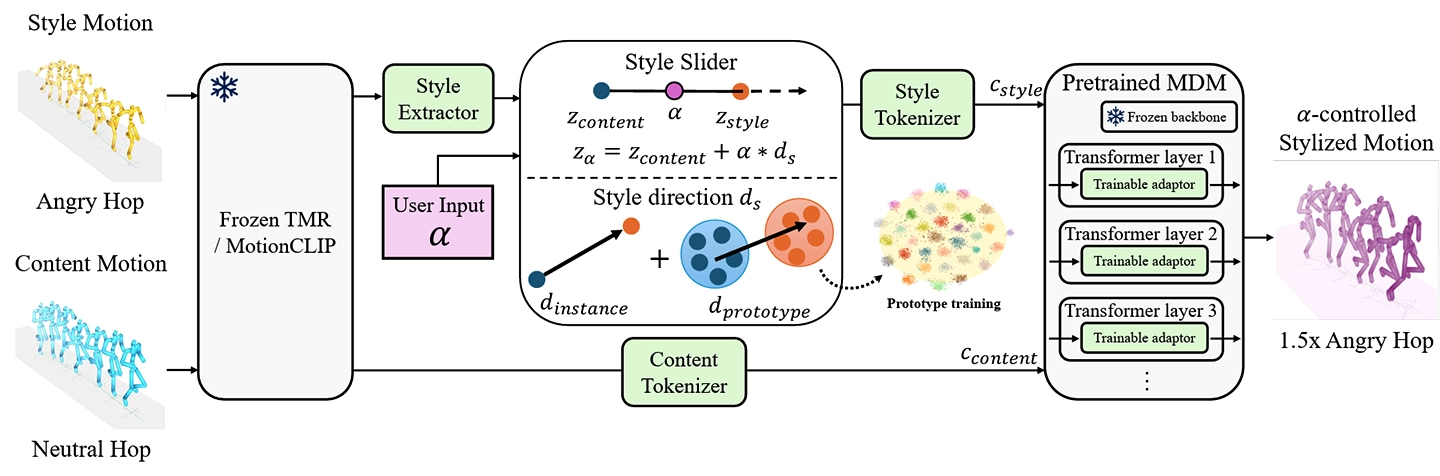
The model derives the direction of style change from the stylized and neutral motions, then feeds style information corresponding to the user-specified slider value α, together with motion-content information, into a pretrained motion-generation model.
The team evaluated the method using multiple benchmark motion datasets and an additional dataset specifically created to assess performance beyond the styles seen during training. The method was compared against established techniques like Multi-condition Motion Latent Diffusion Model and DeepMotionEditing (Aberman et al.). “Compared with existing methods, the proposed strategy achieved favorable results in the consistent control of style intensity, smooth transitions, and extrapolation to highly expressive motion,” remarks Liao. Representative examples comparing the proposed method with existing approaches are shown in Figure 3.
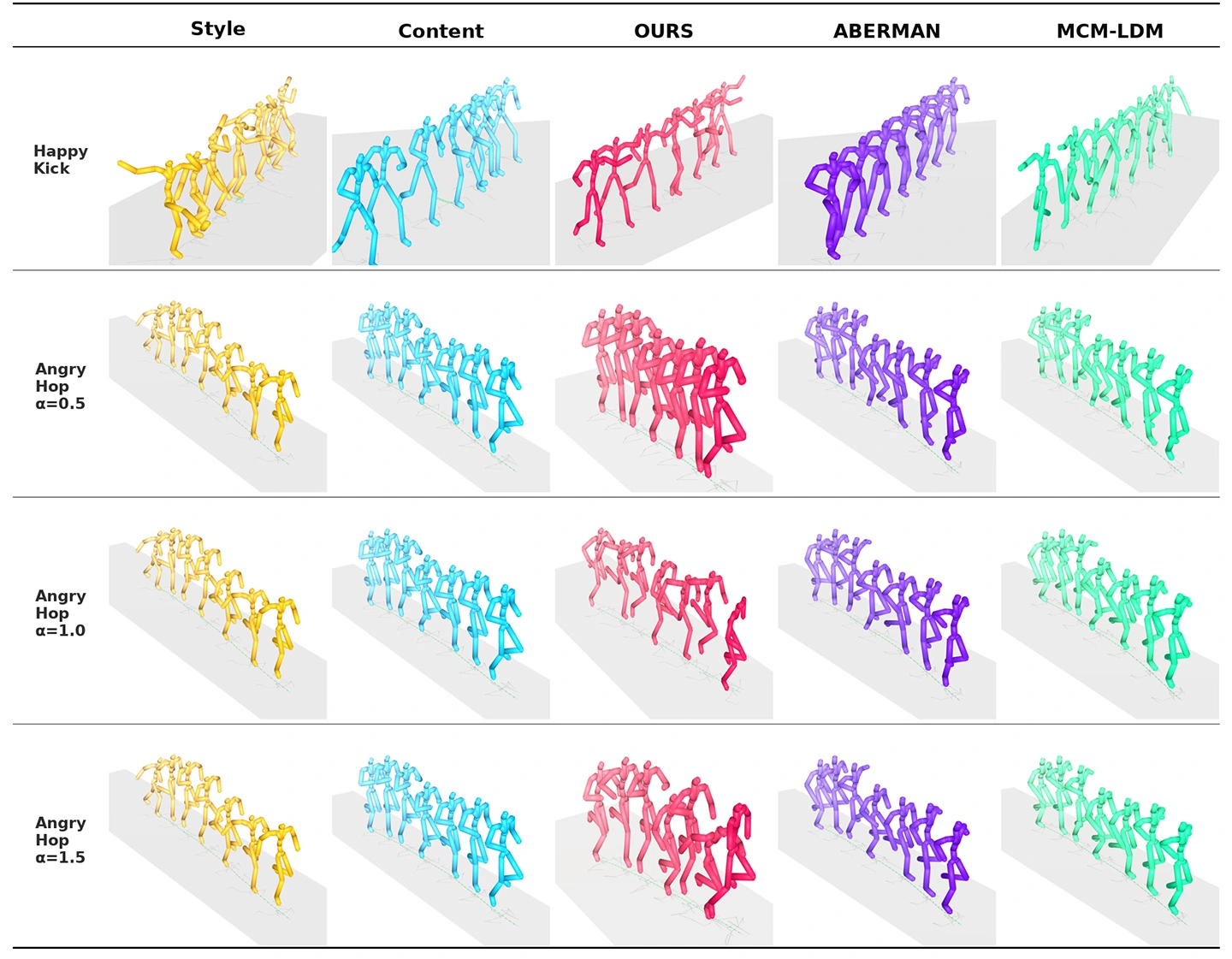
Examples generated by the proposed method (OURS) and existing methods (ABERMAN, MCM-LDM) as style intensity is varied for the same motion content. The proposed method changes the motion progressively in accordance with the specified style intensity.
To further validate the framework’s output, the researchers conducted a Likert-scale user study with 11 university participants who rated the differences in style intensity among motions created by the Motion Style Slider as clearly distinguishable, while their naturalness remained comparable.
The Motion Style Slider provides an intuitive and practical framework that can consistently modulate motion style and intensity, transitions, and nuances of AI-generated human motion. This technology could advance animation workflows in games, films, and other forms of virtual content, letting directors and designers refine character performances according to their exact creative vision.
Reference
- Authors:
- Chen-Chieh Liao1,3*, Yichen Peng1, Yiyi Cai2, Yûi Ono3, Hiroki Hanaoka3, Erwin Wu1, Hideki Koike1, and Shuichi Kurabayashi3
- Title:
- Motion Style Slider: Endpoint-Supervised Continuous Style Control for Human Motion Diffusion
- Journal:
- European Conference on Computer Vision 2026 (ECCV 2026)
- Affiliations:
- 1Institute of Science Tokyo, Japan
2The University of Tokyo, Japan
3Cygames Inc., Japan