
George Orwell imagined Big Brother as an omnipresent dictator with a heavy black moustache and piercing eyes that “follow you about when you move.” His image is accompanied by the slogan, “BIG BROTHER IS WATCHING YOU”, a warning enforced by the two-way telescreens found in every home, workplace and public square.
The dystopian author described 1984 as satire of the “perversions to which a centralised economy is liable.”
“Something resembling it could arrive,” Orwell said in 1949, and now academics argue it has.
Meta’s new AI glasses have restyled Kylie Jenner as an ever-present ‘Big Sister’.
Earlier this month, Facebook’s parent company released its signature line of Kylie ‘Starfire’ smart glasses that feature an AI assistant with her own voice. They retail in Australia for $649.
The social media mogul was just 9-years-old when she began filming Keeping Up With The Kardashians. Speaking on Jake Shane’s Therapuss podcast in January, Jenner described the constant surveillance of reality TV cameras as a “harrowing experience” that made it “hard” to leave the house.
 The Meta x Kylie Jenner Starfire AI glasses include an AI assistant voiced by Kylie. Photo: Kylie Jenner/Instagram.
Professor Dali Kaafar, Executive Director of the Cybersecurity Hub at Macquarie University , says Australian privacy laws aren’t ready for such an intrusion.
“There is a great irony in Kylie, who has spoken openly about the psychological toll of being watched her whole life, becoming the face of a product that wants to normalise covert surveillance,” he says.
“Surveillance is being sold to us as a lifestyle rather than as a technology, and my long-standing view is that the biggest privacy shifts do not arrive through legislation, but through cultural normalisation. Normalisation runs through aspirational culture, and once a technology lands there it becomes very difficult to reverse, or even resist,” he warns.
“But I believe in Australia being one of the very few societies that can and should ban restrict the use of these glasses, except in genuine use cases such as disability.”

Industry insiders speculate the Meta and Kylie Jenner collaboration to be worth US$30million. Photo: Kylie Jenner/Instagram.
Meta’s slick marketing roll out is the same play that worked with early social media: make it aesthetic first and convince the public to argue about the rules later.
Prof. Kaafar thinks Australia should put a blanket ban on the invasive AI facial recognition tech.
“In recent privacy lawsuits involving Bunnings and Kmart, the privacy regulator found they’d collected customers’ biometric data through facial recognition without proper consent,” he says.
Bunnings challenged the outcome and was granted permission to use the technology for security purposes.
“That tells you the law here is unsettled and struggling to keep pace,” Prof. Kafaar says, “and that was just about cameras fixed inside a handful of stores. Now, we’re talking about putting that same capability in the hands of millions of people.”
Smart glasses are not a new technology. Google Glasses, released in 2013, have the same core capability. But wearers were labelled ‘glassholes’, many venues banned them outright, and the controversial product died on arrival.
A decade later, Meta is heavily promoting its new product (with a Super Bowl ad starring Spike Lee, a brick-and-mortar store on New York’s Fifth Avenue, and a donation of 100,000 pairs to blind veterans on US President Trump’s birthday). It appears to be paying off, with seven million sold last year.
“The technology itself has barely changed. What’s changed is the branding,” says Prof. Kaafar, who believes that Meta has done nothing to answer privacy concerns about its product.
“The issue of consent is not really about the wearer of the glasses. It is about everyone else in the frame,” he says.
“The recording indicator light is a weak safeguard at best. It can be trivially disabled (there are plentiful tutorials online), and even when it is lit, no one walking past is meaningfully consenting to being filmed and potentially processed through Meta’s biometric pipeline.”
He points to the online evidence: hundreds of “manfluencer” clips shot by young men on Meta’s glasses: point‑of‑view interactions with women at gyms, beaches and train stations, framed as ‘pick up’ content.
In many cases, the creators also monetise the covert interactions with women into content that amasses millions of views. The unmoderated comments on each video are flooded with sexual and derogatory remarks aimed at the unsuspecting women involved.
One woman in London told the BBC a man secretly filmed her with smart glasses, posted the video where it was viewed 40,000 times, and later requested payment to take it down. The ABC reported a Sydney woman’s “soul destroying” account of being “harassed” by an American content creator who shared a covert video to his 1.3 million Instagram followers.
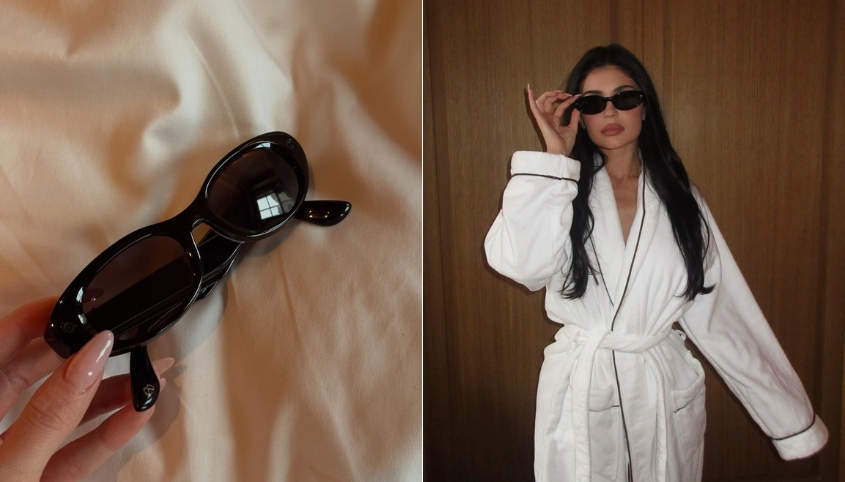 Meta has leveraged high-profile partnerships with Ray-Ban, Kylie Jenner, Jennie from BLACKPINK, Chris Hemsworth, and Chris Pratt to market its AI glasses. Photo: Kylie Jenner/Instagram.
Australian TikToker Blue‑Eyed Kayla Jade has urged her 3million followers not to buy into the hype. “As someone who has been filmed without her consent, I know that Kylie Jenner’s collab with Meta glasses is going to cause more harm than good to women,” she shared . “I don’t think this campaign is about getting women to buy Meta glasses; I think it’s about making everyone else feel comfortable around the creepy men already wearing them.”
On that point, Prof. Kaafar says Meta’s advertising of smart glasses “undersells the problem.”
“These devices are not just wearable cameras,” he stresses. “They are a continuous, first-person feed that serves as an input pipeline for AI data collection and model training.”
He likens the glasses to “wearing a stalker on your face,” and is concerned we have “a very short collective memory,” about Meta’s business practises. The company has already paid more than US$7 billion in settlements and fines for privacy violations.
Two Harvard students showed that by pairing Meta’s glasses with off-the-shelf facial-recognition software, they could identify strangers; finding names, addresses and personal phone numbers, within seconds. In a leaked internal memo , Meta said political tumult in the United States would distract critics from their facial recognition feature’s release.
Then in March, Swedish journalists revealed that third-party contractors in Kenya had reviewed intimate footage, private messages and banking details captured through Ray-Ban Meta smart glasses. More than 1,000 low-paid Kenyan data-labelling workers lost their jobs shortly after the investigation became public.
Meta now faces a class action over alleged false advertising and consumer deception. “Designed for privacy, controlled by you,” might be the slogan on the box, but Meta argues the fine-print T&C’s give implicit consent to share and store users’ data any time they use look-and-ask AI functions.
“The Australian regulatory context is genuinely not built for this,” Prof. Kaafar stresses.
Currently in Australia, each state and territory has its own surveillance devices laws that dictate people’s rights. Under the Surveillance Devices Act in NSW, recording a conversation without all parties’ consent can carry a penalty of up to five years imprisonment. While other states have a Human Rights Act that includes a right to privacy.
While it is legal to film people in public, the covert nature of Meta’s glasses, and repeated targeting of women by wearers has raised legal and ethical questions about who this technology benefits.
“The Privacy Act review has been protracted. We now have a statutory tort for serious invasions of privacy, which is a step forward, but it’s a high-threshold, after-the-fact civil remedy—not a control on the devices themselves,” Prof. Kaafar says. “The OAIC is under-resourced for something that could reach the mainstream very quickly. If people begin wearing these devices to the shops in the way they now wear Air Pods, the person on the other side of the interaction has almost no legal protection.”
That’s why he “totally supports” placing a moratorium on their sale. “I don’t think many Australians want being unrecorded in public to become an afforded luxury,” Prof. Kaafar adds.
“More often than not, society asks the wrong questions of new technology. Can we? The real question is, should we?”




/health-and-multilateral-partnerships-(hmp)/who-commonwealth-secretariat-mou-signing-2026.tmb-768v.jpg?sfvrsn=834ff601_2)


