Electric fields can reliably reverse magnetization in nanoscale structures of the multiferroic material BiFe0.9Co0.1O3 (BFCO), as reported by researchers from Science Tokyo. Multiferroic materials display coupled electric and magnetic order, making them attractive for low-power memory devices. The team fabricated 190 nm BFCO nanodots and used advanced imaging techniques to directly observe the restructured electric polarization arrangement upon applying an electric field, driving a persistent reversal of magnetization.
Controlling Magnetization at the Nanoscale Using Electric Fields
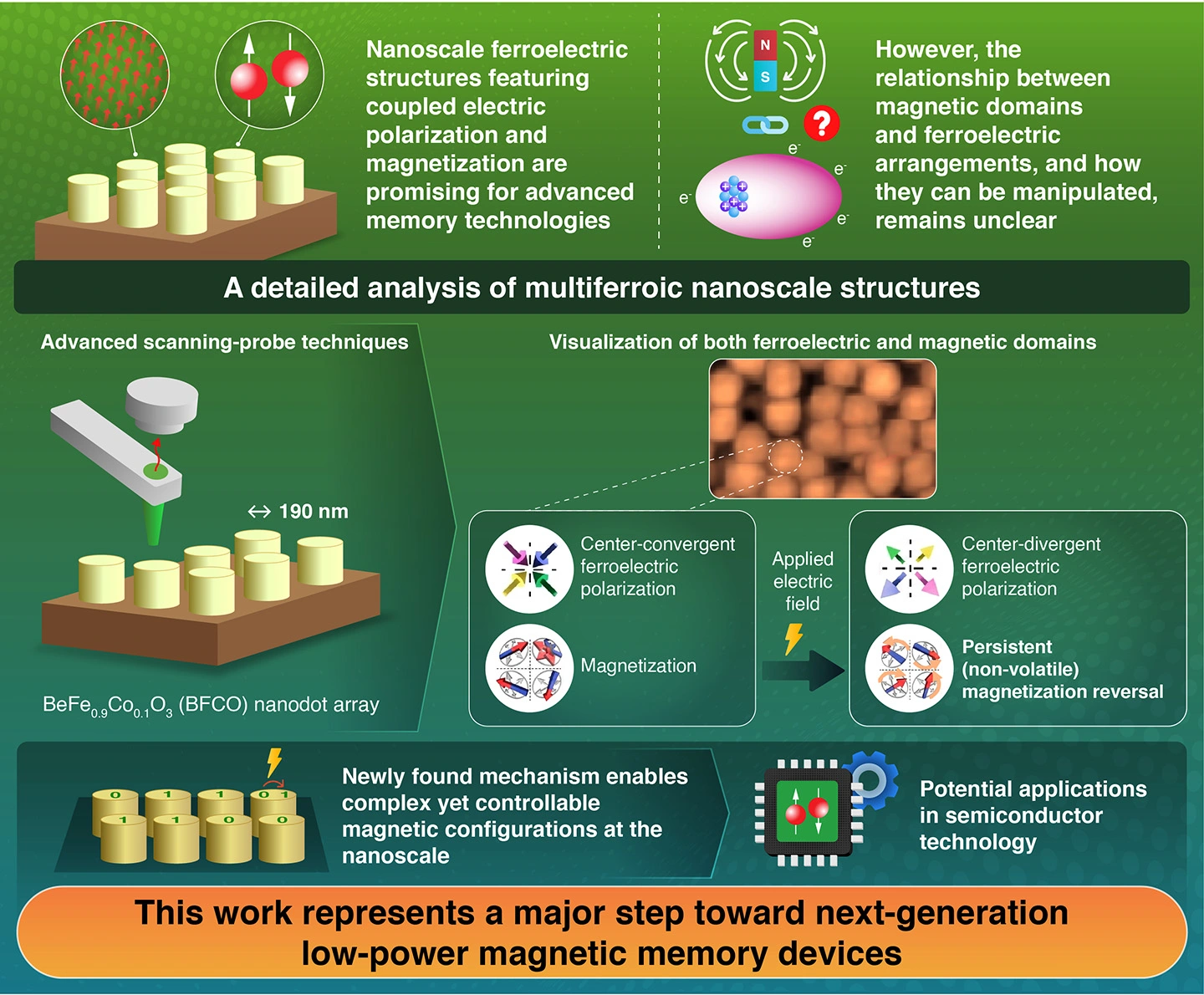
With the rapid spread of cloud computing, artificial intelligence, and data centers, global energy consumption is rising to new heights. A promising way to reduce this burden is to develop memory devices that store information magnetically yet are written using electric fields. Magnetic memories are non-volatile, meaning stored information is retained without a power supply. However, the conventional method of writing to magnetic memory relies on the magnetic field induced by electric currents, which inevitably dissipates energy as Joule heat. Instead, using an electric field to switch the magnetic state would realize a pathway to significantly more energy-efficient memory devices.
Multiferroic materials, which simultaneously display both electric and magnetic order, are a potential route towards this goal. Because both types of order are coupled, applying an electric field to these materials can cause their magnetic state to flip. For these materials to find use in real memory devices, however, their behavior at nanometer scales must be demonstrated; at those dimensions, materials can develop complex polarization arrangements called topological domain structures, whose relationship to magnetic behavior is less clear.
To address this knowledge gap, a research team led by Assistant Professor Kei Shigematsu from Institute of Science Tokyo (Science Tokyo), Japan, along with JSPS Postdoctoral Fellow Koomok Lee and Professor Masaki Azuma, also from the same institute, in collaboration with the Sumitomo Chemical Next-Generation Eco-Friendly Devices Collaborative Research Cluster, Institute of Integrated Research, Science Tokyo, and the Kanagawa Institute of Industrial Science and Technology (KISTEC), Japan, studied the electric and magnetic behavior of nanoscale structures made from the multiferroic material BiFe0.9Co0.1O3 (BFCO) in detail. Their findings were published in Volume 12, Issue 25 of the journal Science Advances on June 17, 2026.
The team fabricated arrays of BFCO nanodots, each roughly 190 nm in diameter. Using two complementary imaging techniques-piezoresponse force microscopy to map electric polarization and scanning nitrogen-vacancy center magnetometry to detect magnetic fields-they visualized both the electric and magnetic domain structures of the nanodots before and after applying an electric field.
Each nanodot originally exhibited a “center-convergent” electric polarization structure, where polarization vectors all pointed inward toward the center. Applying an electric field transformed this original state into a “center-divergent” structure, with polarization vectors pointing outward. This restructuring was accompanied by a reversal of magnetization in both the in-plane and out-of-plane directions within each nanodot.
Notably, this reversal does not occur through a simple flip of individual electron spins. Instead, the magnetic moment rotates in the easy plane, which are the preferred orientations for magnetization in the material, in response to the polarization switching, driving the magnetization into a reversed configuration. This gives the approach a degree of controllability that is promising for practical applications, as Shigematsu explains: “This mechanism enables complex yet controllable magnetic configurations at nanoscale dimensions relevant to semiconductor devices.”
The findings of this work could have important implications for next-generation memory technologies. By enabling magnetic information to be written electrically and read magnetically, such devices could combine low energy consumption with non-volatile operation. “Compared to current-based technologies such as spin-transfer torque magnetic RAM, this approach could significantly reduce energy consumption,” remarks Shigematsu. Moreover, the complex domain structure of a single nanodot could in principle encode multiple magnetic states, opening the door to higher-density memory architectures that go beyond storing binary values.
Overall, the study provides a concrete experimental foundation for designing next-generation, ultra-low-power magnetic memory devices using multiferroic materials.
Reference
- Authors:
- Koomok Lee1,2,3, Peter Meisenheimer4, Paul Stevenson5, Yasuhito Nagase2, Kei Shigematsu1,2,3,6, Ramamoorthy Ramesh4,7,8, and Masaki Azuma1,2,3,6
- Title:
- Electric Field-Induced Ferromagnetic Domain Change by Ferroelectric Topological Domain Switching in Co-Substituted BiFeO3 Nanodots
- Journal:
- Science Advances
- Affiliations:
- 1Research Center for Autonomous System Materialogy, Institute of Integrated Research, Institute of Science Tokyo, Japan
2Materials and Structures Laboratory, Institute of Integrated Research, Institute of Science Tokyo, Japan
3Sumitomo Chemical Next-Generation Eco-Friendly Devices Collaborative Research Cluster, Institute of Integrated Research, Institute of Science Tokyo, Japan
4Department of Materials Science and Engineering, University of California, USA
5Department of Physics, Northeastern University, USA
6Kanagawa Institute of Industrial Science and Technology, Japan
7Materials Sciences Division Lawrence Berkeley National Laboratory Berkeley, USA
8Department of Materials Science and Nanoengineering, Department of Physics and Astronomy, Rice University, USA