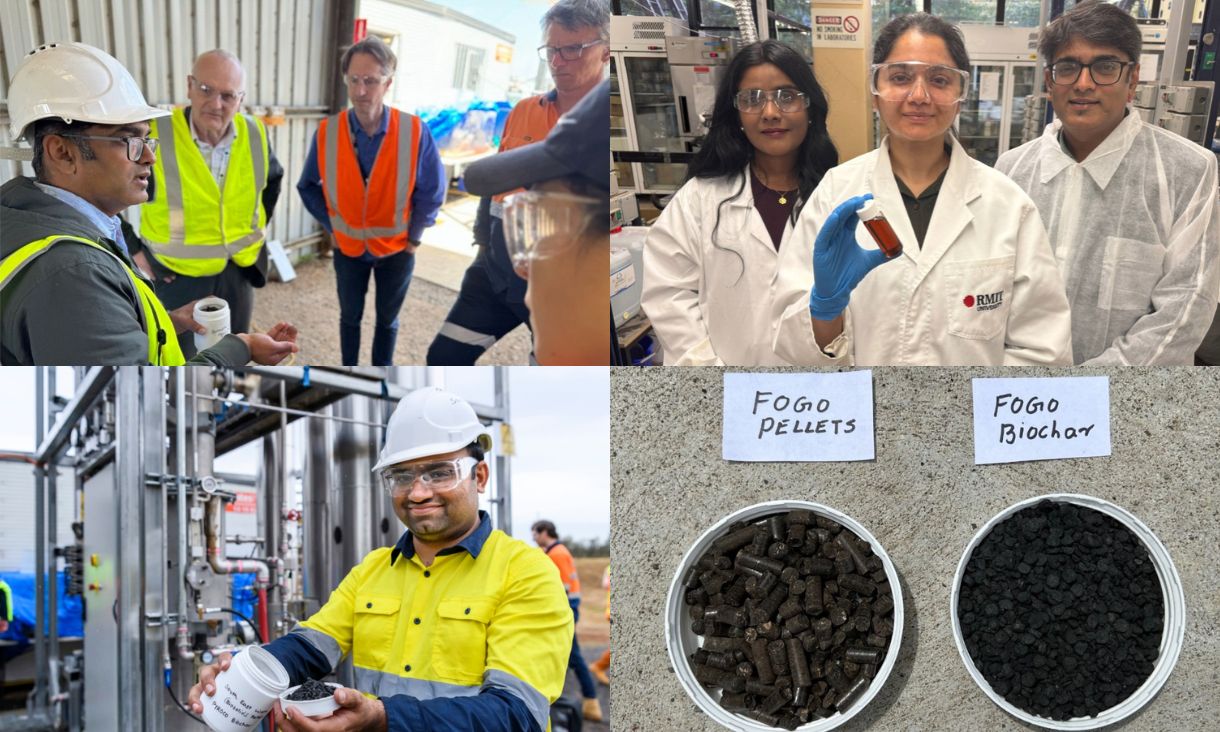
RMIT will lead the RENEW Organics Hub, which will bring together academic, industry partners and government to support Australia’s energy transition.
RENEW has received almost $5 million from the Australian Research Council (ARC) as part of the latest round of the Industrial Transformation Research Hubs initiative.
This investment will fund the RENEW Organics Hub, which will focus on three key themes: carbon recovery and advanced materials, renewable energy and fuels, and nutrient recovery and biofertilisers.
The Hub is a cross-sector collaboration involving academic, industry and government partners, and aims to produce high-quality research that can be translated into real-world impact.
Professor Kalpit Shah, Deputy Head of Chemical and Environment Engineering, Research & Innovation in the School of Engineering, will serve as the Director of RENEW.
Shah and RMIT will lead a consortium of Australian universities working at the Hub, including University of Technology Sydney, The University of Queensland, The University of New South Wales, The University of Western Australia, and Curtin University.
Major industry partners include Melbourne Water, Urban Utilities, Water Research Australia, Intelligent Water Networks, Saunders International, Hart Bioenergy, Water Corporation, EPA Victoria, and Barwon Water.
Professor Catherine Itsiopoulos, Deputy Vice-Chancellor STEM College and Vice-President RMIT University, said the Hub highlights RMIT’s leadership in areas of national priority such as energy security.
“RMIT is committed to delivering research and innovation that meets the needs of industry while advancing environmental protection for the wellbeing of individuals, societies and ecosystems.
“This Hub is an excellent example of how RMIT’s applied research environment, focused on interdisciplinary collaboration with industry partners, is uniquely set up to deliver innovative solutions towards a more sustainable, resilient energy future for Australia.”