Australia’s transition to a low-emissions future will depend on smarter energy systems, new technologies and the skilled workforce needed to support them.
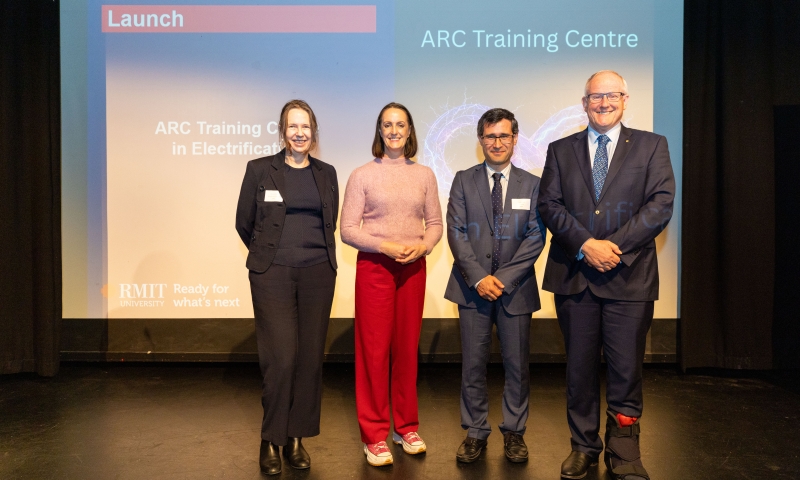
Professor Alison Ross, Ms Sarah Witty MP, Professor Mahdi Jalili and Professor Calum Drummond at the opening of the ARC Training Centre in Electrifying Australia for a Net Zero Future.
As more Australians install rooftop solar, switch to electric vehicles and embrace electrified technologies, the nation’s electricity network is facing growing demands. Ensuring the grid remains reliable, affordable and resilient while integrating more renewable energy is one of the key challenges of the energy transition.
The ARC Training Centre in Electrifying Australia for a Net Zero Future, officially launched at RMIT University, is helping tackle this challenge. Bringing together researchers, industry partners and government, the Centre is developing practical solutions to support Australia’s path to net zero while training the next generation of energy leaders.
Building a smarter energy system
The Centre combines expertise from engineering, economics, mathematics, chemistry and artificial intelligence to address complex challenges facing Australia’s energy network.
Its work focuses on 3 key priorities: supporting households and businesses to adopt electrification technologies, transforming energy distribution systems to manage growing demand and renewable energy generation, and using data-driven approaches to improve planning and decision-making across the electricity system.
By bringing together expertise from multiple disciplines, the Centre is ensuring solutions are practical, scalable and ready for real-world implementation.
Turning research into real-world solutions
The Centre’s research is already helping address some of the most pressing challenges facing Australia’s energy system.
Projects are exploring new ways to integrate renewable energy into the electricity grid, helping maintain reliable access to clean energy as renewable generation continues to grow. Researchers are also investigating how rooftop solar can be used more effectively, enabling households to make better use of the energy they generate while supporting the broader electricity network.
Another area of focus is electric vehicle charging. The Centre is developing machine-learning tools to better understand charging patterns and predict future demand, helping energy providers maintain system stability as EV uptake increases.
Training Australia’s future energy workforce
Alongside its research program, the Centre is helping build the workforce needed to support Australia’s energy transition.
23 PhD candidates will undertake industry-embedded research projects, gaining hands-on experience while working alongside industry partners. This model helps ensure graduates develop both the technical expertise and practical experience needed to address future energy challenges.
Supported by $5 million from the Australian Research Council and more than $11 million in partner contributions, the Centre represents a significant investment in Australia’s future energy capability.
By connecting researchers, industry and government, the Centre is helping transform research into practical solutions that will support a cleaner, more reliable and more resilient energy future for Australia.