
Key Points
Research led by the Australian Institute of Marine Science has provided new insights into how heat-evolved algae, an energy source for coral, withstand heat stress
The findings could lead to approaches to improve coral resilience in a warming climate
The team used infrared microspectroscopy to generate biomolecular “fingerprints” of individual algal cells
A research team led by the Australian Institute of Marine Science (AIMS) has found that heat-evolved algae maintain more stable biomolecular profiles under elevated temperatures than their non-evolved (wild-type) counterparts, providing new insights into how they withstand heat stress.
The findings, published in New Phytologist, could help scientists develop new approaches to improve coral resilience in a warming climate.
Coral reefs, such as the Great Barrier Reef, depend on microscopic algae living inside their tissues. These algae can occur at densities of around one million cells per square centimetre of coral tissue and provide much of the energy corals need to survive. However, rising ocean temperatures can disrupt this relationship, leading to coral bleaching.
Previous research has shown that algae experimentally evolved to tolerate higher temperatures can improve coral survival during heat stress. However, the biomolecular mechanisms underlying the algae’s increased thermal tolerance have remained poorly understood.
To address this gap, AIMS scientist Dr Bede Johnston conducted experiments at the National Sea Simulator (SeaSim) at AIMS before using the Infrared Microspectroscopy beamline at the Australian Synchrotron to generate biomolecular “fingerprints” of individual heat-evolved and wild-type algal cells.
He completed the research as part of his PhD at the University of Melbourne and through the Reef Restoration and Adaptation Program (RRAP).
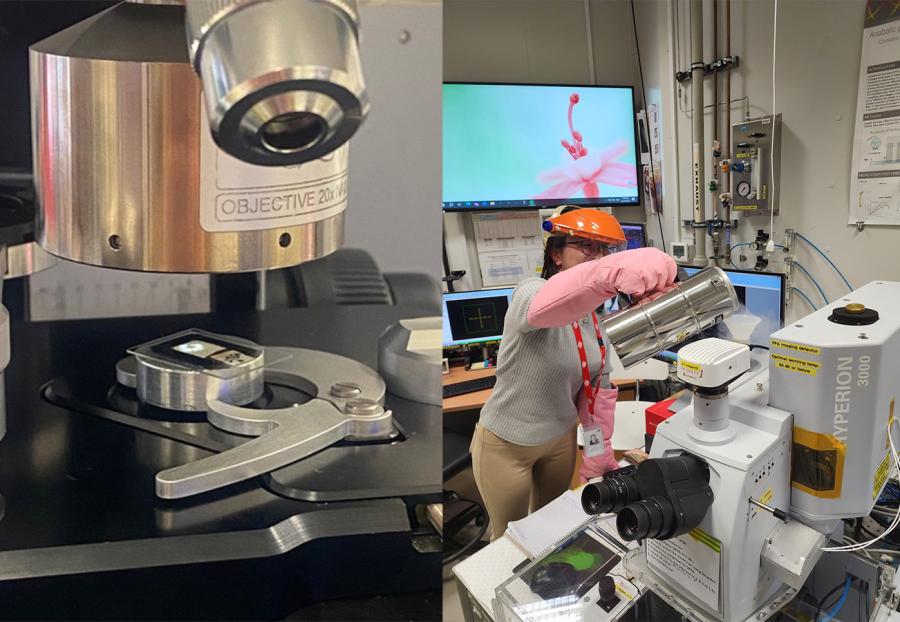
Australian Synchrotron beamline scientist Dr Annaleise Klein, a co-author of the study, collaborated on measurements of proteins, lipids, carbohydrates, and other molecules in the algae. The team examined the two symbiont strains across three different environments: living inside corals, growing independently in culture, and after being expelled from their hosts.
“We wanted to understand how heat-evolved algae respond to heat stress in different environments, and whether living inside or outside their coral hosts influenced these responses,” said Dr Johnston.
The researchers found that wild-type algae exhibited changes in their biomolecular composition under elevated temperatures, while heat-evolved algae generally maintained more stable profiles.
“We observed increases in carbohydrates and changes in protein-associated molecules in the wild-type algae, consistent with a cellular stress response. In contrast, the heat-evolved symbionts showed a much more subdued stress response to elevated temperatures” explained Dr Johnston.
Interestingly, the responses also varied depending on the environment the algal cell was in, highlighting how the coral host and surrounding conditions can influence the way symbionts respond to heat stress.
These findings provide a better understanding of how heat-evolved symbionts tolerate elevated temperatures, offering valuable insights for ongoing efforts to improve coral resilience to ocean warming.
“Ultimately, we’re interested in introducing these heat-evolved algae to reef environments, where they could be taken up by corals and potentially improve their resilience to rising ocean temperatures. Understanding what makes these algae more heat-tolerant is an important step towards that goal,” said Dr Johnston.


